
@tkb.studio • www.tkb.studio •
5 Questions:
1. In the lull between Christmas and New Year’s, I bring homemade pierogi to lunch with Babcia. She smiles at the familiar flavors—potatoes, mushrooms, onions—and says again, “Starosc nie radosc.” Getting old is no joy. She’s been saying that for twenty years.
While the tea brews, I notice a photo of my grandfather standing beside a man in a leopard loincloth. “What’s this?” I ask.
Her eyes widen. “You don’t know? Dziadusz was in Africa. During the war. While I was in Siberia, and Tashkent, and India…” She begins to speak, and the silence of generations begins to unspool.
She was 17 when they were deported from eastern Poland—The Kresy. Her family lived in a farmhouse, dreaming simple dreams: school, farming, family. But war tore it all apart. The Soviets labeled Poles enemies of the state, and in 1941, her family was packed into a freezing cattle car to Siberia. Seventy people per car. One hole in the floor. One window. One bucket of water a day. Starvation began immediately. Her mother packed for winter, even though it was June. That’s why they survived. After “amnesty” was declared, they fled Siberia via Dodge military truck—1200 miles on dusty roads—and then by train to Tashkent. From there, they reached India, where a maharaja offered sanctuary to nearly 5,000 Polish children. My grandmother was one of them.
My grandfather, meanwhile, fought with the Polish Resistance alongside the British Army in Italy. They reunited in England, married, and started a family. In 1953, they immigrated to America, landing in Montreal on Christmas Eve and eventually settling in Chicago.
Years later, my father returned to Poland for school. He met my mother at university, and she immigrated in 1975, escaping communism. They married that summer. My brother was born ten months later.
I grew up in-between: Polish at home, English at school. Rooted in exile, raised on stories wrapped in silence. These are the stories behind the pierogi, the photos, the pauses. This is the history I carry—in my art, in my bones, and in every question I finally dared to ask.
2. I am the first-generation daughter of refugees and immigrants. My family’s journey ranges from Siberian exile to a refugee camp in India, to England, Detroit, Chicago, Belize, and back again. It’s not just in our photo albums. It lives in my nervous system, and in how I see the world. I grew up between worlds. At home, we spoke Polish, made pierogi, looked at photos steeped in memory — places held in hearts, places I had never seen. At school, I spoke English, learning quickly to edit and explain, to soften and translate. I was raised in a Polish community that preserved our culture like crystal: precious, hard, and closed; the impact of war something I wouldn’t fully comprehend until my 30s and 40s, a childhood shrouded in silence. To belong, I had to learn to read what was never spoken: quiet pain, buried stories, inherited longing, and a relentless will to keep going.
There was pride, but often in hiding. Poles were the punchline of jokes during my childhood. And yet I knew the truth: my ancestors had fought with valor, shared their knowledge across continents, brought beauty and innovation wherever they landed. We were not what they thought. We were not even what we said aloud.
That duality — being shaped by a story the world I was in didn’t recognize — has made me a careful listener, a cultural code-switcher, a keeper of nuance. It has taught me to build bridges where others see fences.
And yet I still feel split. Not fully American, because I was raised knowing that safety is a myth that can vanish with a border. Not fully Polish, because displacement rewrites even the language of belonging. What I’ve inherited is a sense of motion. A deep empathy for those who live in liminal spaces, holding children across waters to find safety, carrying dreams into new lands. I hold a reverence for stories carried in bone and silence — and a belief that art can stitch together what exile has scattered.
3. Home, for me, has never been a single place; it’s the feeling in my heart, a trusting hand in mine, a memory of something carried, like a fragment of a map, a scrap of textile passed down through memory, language, and longing. I have taken the essence of our traditions and celebrate them with my own style: holiday gatherings feature foods of the past as well as our modern interpretations. We celebrate beauty and nature, but we do not sing the old songs or follow the old religion.
4. Every time I read the news of refugees crossing the southern border, of families evacuated from Afghanistan, of people walking across treacherous terrain just to survive, I feel it: the ancient, familiar pull. I see my grandmother standing in the back of that Dodge military truck, her mother beside her, emaciated but determined. I see my grandfather in his uniform, liberating Italy while dreaming of home, where he would never return. Their story lives in the stories unfolding now.
I don’t try to reconcile it—I respond to it. As an architect, I create shelter, safety for families, a refuge from the chaos of the world.. As an artist, I create sanctuary for the soul. My creative practice shines a light on the ongoing story of the refugee community and offers solace to those in motion. I have inherited displacement, and I’ve chosen to turn that inheritance into safety, through spaces, images, and stories where others can find themselves and feel less alone.
5. My hope is centered around the restoration of peace, dignity, memory, and belonging. I build spaces — both physical and emotional — that offer people the same thing my ancestors longed for: safety, beauty, and home.
As an architect, I design spaces that will hold the stories of future generations — refuges that help the people who live in them feel connected to their family, their past, and their future, while offering shelter and warmth.
As an artist, I weave stories of displacement and sanctuary, giving light to wonder and home. My paintings are places of calm, of magic and reflection — inviting joy and welcoming grief in equal measure.
I am crafting a legacy that says: we were here, and we made beauty anyway.
___
Bio | Art Statement
Tai is a first-generation daughter of refugees and immigrants, an architect by training and an artist by calling. Her work explores memory, migration, and the idea of sanctuary – both structural and symbolic — offering refuge, resonance, and beauty.
___
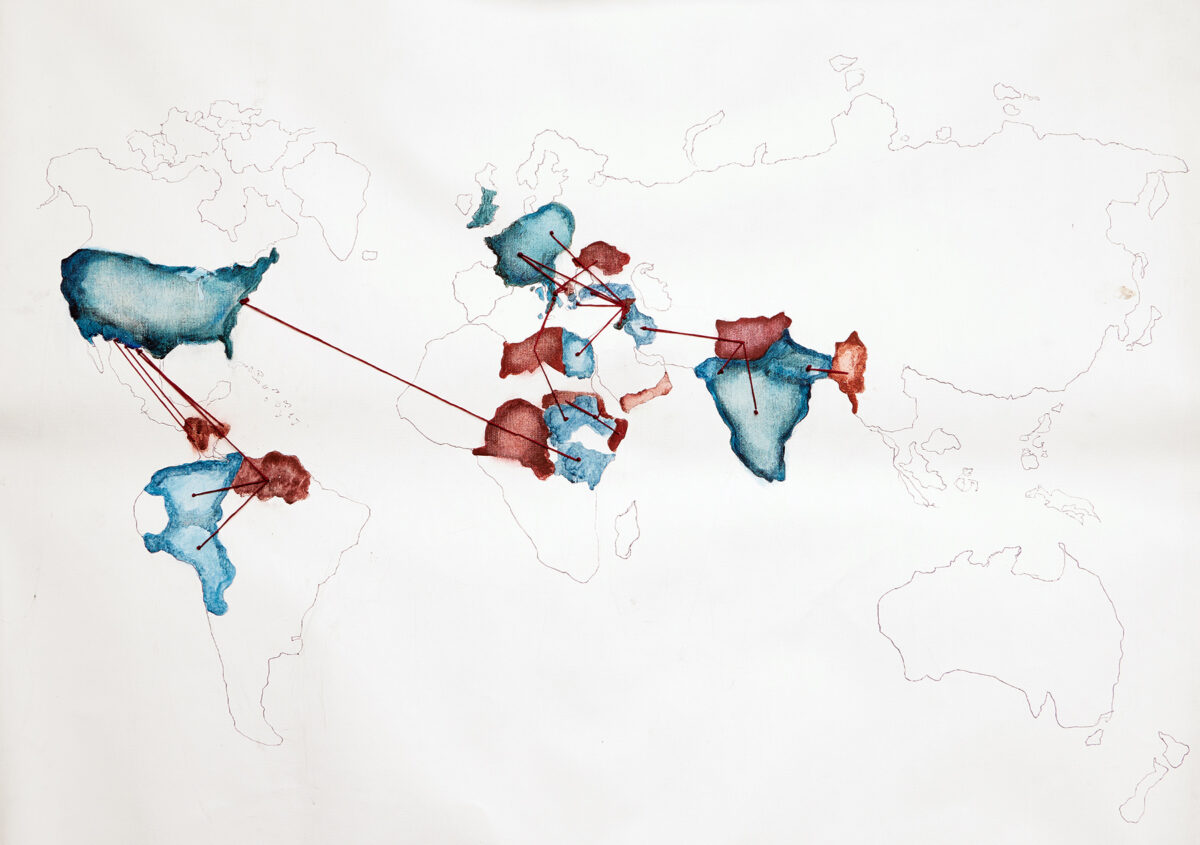
refugee paths, 2019, acrylic and thread on canvas. Tracing of the paths of refugees in 2019.
My family crossed continents under duress—Siberia to India, England to America—fueled by survival and longing. I carry that legacy as a first-generation daughter of refugees, split between cultures, fluent in silence and story.
These same stories are happening today, fueled by climate change, war, and uncertainty. No one puts their child in a boat unless we think the other side is safer.
We can all provide that safety.
______
Featured Artists | Akira – Light that Heals • Alejandra Lemus • Angie Zaveleta • Anna Silivonchik • Bane-xxa • Calayah • Catherine Economopoulos • Christian Joshua Varela Solis • Cindy Uriostegui • Darth Rudo • El Poeta • Grecia Solorio • Idil Duman • Javier Viñuela • Jimena Hernández Aguilar • Julia Obrien • Kaltra • Kybo • Lorena Salinas • Lydia Gunn • Mariana Perez • Mary Antar • Michael Azpeitia • Papaya Guayaba • Peauxline • Rita Garcia Šindelář • Roele Phantom • santi[ago alvarado] • Schantelle Alonzo “Mishipiku” • Scribe • Tai Kojro-Badziak • Toni Maugeri • Valeria Osornio • Victoria Park • Victoria-Riza • Yekseny Guerrero