
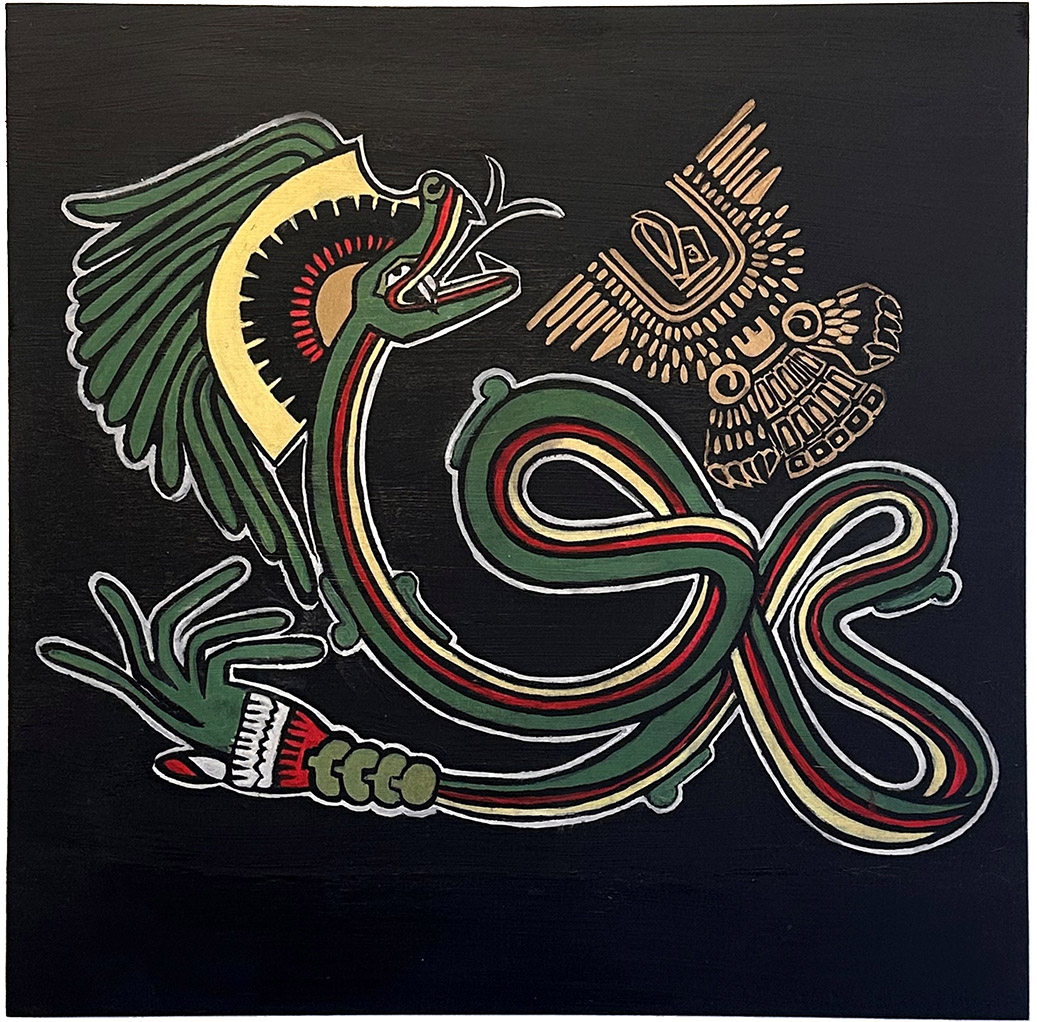
@bane.xxa • Kukulkan, Painting •
5 Questions:
1. Consistent economic struggles, my oldest brother’s health issues, and a third child on the way (me) pushed my family to immigrate to the U.S. This journey played out in three different steps. First, my father came to Chicago, joining his sister, her husband, and nephews’ household. His main goal was to gather funds for our passage. This took about a year and some months. During this time my mother not only had to manage her high-risk pregnancy with no partner but was also responsible for raising two young boys. Once I was ten months old, my brothers and I (4 & 5) made our way by airplane with two family members who claimed we were their children. Finally, about a week or two later and after four failed attempts, my mother and my cousin made it to Douglas, Arizona by foot.
2. My relationship with both my family and community has been wrought but is in the process of reconciliation. While there has always been a sense of pride in my Mexican identity, as a child and teen, there was a simultaneous deep shame and resentment that always loomed. Although I was raised in a very Mexican Chicago community, my connection with my peers always seemed to be stifled as ethnic relatability was not enough to bridge the experience of living with a different status. In my family, this confusion caused deep disconnection and misunderstanding. After explosive conflicts, continuous education, and a learned appreciation of our material conditions, I have developed both a deeper understanding and bond with my family and have reshaped my view of community to be defined in terms of my relationality and mutual dependency.
3. Honestly, my relationship with tradition is not very strong, but my relationship with home is defining; it is grounding and guiding. When I was younger my family engaged a lot more with Mexican Catholicism, but that fell off over time. My family does not necessarily abide by any strict norms now, although those elements still linger in expectations and responsibilities, which, I guess, are the elements of traditionalism that are still relevant to me. Today, home is less defined by my ability to meet any essentialist standard and more defined by the knowledge of my family’s trajectory and the things we have been subject to because of our geography, ethnicity, and health.
4. I feel the pull between my present life and my roots the strongest when I have put myself in those positions where I have learned most about myself— that being in the higher academic setting and in my intimate relationship Americanness (U.S. specifically) and Whiteness. These encounters have brought about many existential dilemmas and doubts about my personal allegiance to both my people, morals, and values. I cannot say that I have ever found a way to truly reconcile this, but I do find endless relief in immersing myself in cultural studies about my heritage, Latinx arts, and deconstructing the systems that bring about these dilemmas to begin with (racial capitalism, patriarchy, etc).
5. My hope is centered around understanding my intrinsic dependencies; those many layered and complex bonds which make both those perceived peers and opponents my kin. In understanding exactly what it is that I cannot escape from and what cannot escape itself from me, I feel empowered in acting, and recognize that every day and the minute is quite grand and consequential.
At the moment, I dream of making visible the imprint of construction painters, those tradespeople who make my life continuous and provide me with endless knowledge and wonder, in our everyday lives across time and space.
___
Bio | Art Statement
Bane.xxa is a local Pilsen artist originally from the Southeast side of Chicago. Bane.xxa’s artistic endeavors are a private exploration into their labor, material conditions, Latinidad, disability, and friendships. Bane deeply resonates with the notion that the “local is global” and utilizes her art to mythologize a more inclusive Latinidad, draw connections between global labor forces, and imagine expansive kinship networks otherwise obscured.
______
Featured Artists | Akira – Light that Heals • Alejandra Lemus • Angie Zaveleta • Anna Silivonchik • Bane-xxa • Calayah • Catherine Economopoulos • Christian Joshua Varela Solis • Cindy Uriostegui • Darth Rudo • El Poeta • Grecia Solorio • Idil Duman • Javier Viñuela • Jimena Hernández Aguilar • Julia Obrien • Kaltra • Kybo • Lorena Salinas • Lydia Gunn • Mariana Perez • Mary Antar • Michael Azpeitia • Papaya Guayaba • Peauxline • Rita Garcia Šindelář • Roele Phantom • santi[ago alvarado] • Schantelle Alonzo “Mishipiku” • Scribe • Tai Kojro-Badziak • Toni Maugeri • Valeria Osornio • Victoria Park • Victoria-Riza • Yekseny Guerrero