
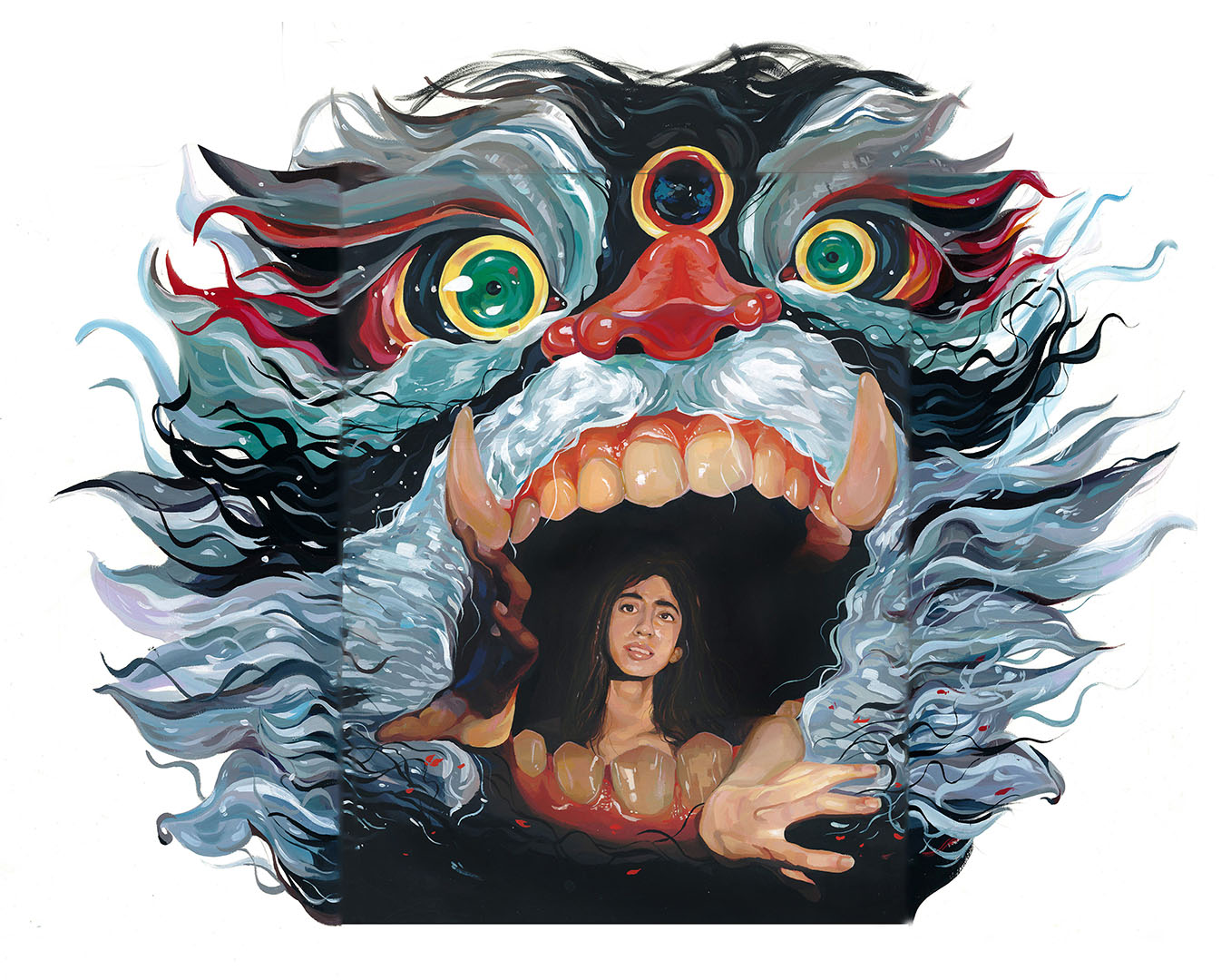
@sailee.charlu | Swallowed by Silence | Digital Print 19×13

Painless Thorns | Digital Print 13X19
Sailee Charlu is a visual artist and spoken poet based in Orange County, CA. She has spent five years training in an arts conservatory for visual arts and creative writing. As a multi-time National Scholastic Gold Medalist and Region-at-Large American Visions Awardee in her visual arts work, her work has been recognized for its emotional depth and narrative clarity. Her art has been published in Celebration Art and Inkblot Magazine. Working across many mediums, Sailee explores memories and emotions as fluid and fragmented, inherited, and constantly reinvented. Through layered imagery, she challenges her viewer to interpret each piece in relation to their own lived experiences.
5 Questions
1. My family’s journey to the United States began with my grandparents, who left poor villages in India during the era of the Cold War and Vietnam War, when America was recruiting labor and skilled professionals. They did not leave because it was easy or glamorous. They left because staying meant limitation of income, education, and freedom to imagine a different future for their children. They crossed oceans carrying degrees, faith, and the weight of everyone left behind.
I think often about what it means to leave the only soil you know, to trade familiar streets, languages, and faces for a place where even your name may be mispronounced. My grandparents entered a country that offered opportunity, but also loneliness, racism, and the pressure to prove they belonged. They worked relentlessly so that their children and grandchildren could inherit choices they never had. Their journey was powered by the most human force there is, love expressed through sacrifice.
2. My family’s immigration story has taught me that love is often quiet. It is not always spoken directly. Sometimes it looks like long work hours, tired hands, strict expectations, and parents who worry because they know how fragile security can be. It has made me understand that many comforts that I take for granted were built by people who swallowed homesickness and exhaustion so that next generation could feel safe.
My community has always extended beyond my own ethnicity. Growing up in immigrant neighborhoods, I saw Latino, Asian, and working-class families carrying similar burdens and hopes in their pockets. I saw parents juggling multiple jobs, grandparents raising grandchildren, neighbors translating for one another, children learning to navigate worlds that their parents could not fully access. My community feels multilingual, resilient, tender, and hardworking, a place where survival becomes generosity.
3. When I was younger, tradition sometimes felt like distance. It was rituals I could not fully understand, prayers spoken in words I only half knew, customs that made me feel like I was standing outside a door everyone else could open. I sometimes confused assimilation with progress, believing that becoming more American meant leaving certain parts of myself behind.
As I’ve grown older, I see tradition differently. I now understand that every recipe, song, prayer, and phrase survived because someone chose to carry it through hardship. Tradition is not a cage, it is evidence that my family endured. Home is no longer just one geography. It is the smell of food in the kitchen, the cadence of my mother’s voice, the stories of relatives I never met, the spiritual language of my grandparents, and the values that traveled farther than any suitcase could hold.
What once embarrassed or confused me now feels sacred. I no longer want to escape inheritance. I want to understand it.
4. I feel that pull most strongly in language. At home, Tamil lives in fragments. In my community, I became fluent in Spanish. In public, I move through American culture. There were times I felt split into versions of myself, never Indian enough, never fully American, always translating something invisible. Even hearing my own name said incorrectly could make me feel the distance between where I came from and where I stood.
I also feel the tension in generational expectations: honoring sacrifice while wanting freedom, respecting traditions while questioning parts of it, carrying gratitude without losing individuality. I reconcile those feelings through art. Poetry has become the place where contradiction has allowed us to breathe. On the page, I do not have to choose one language of the heart. I can be shaped by many worlds at once. Art taught me that identity does not need to be pure or singular to be whole. Sometimes reconciliation is not solving the tension, it is learning to sing inside it.
5. My hope is centered around transformation. Taking the sacrifices of previous generations and turning them into something larger than personal success. My grandparents crossed oceans for possibility. I want to honor that journey by creating possibilities for others.
I dream of using art, education, and advocacy to build bridges between communities that are often separated by language, class, or culture. I want young people from immigrant and underserved backgrounds to feel that their stories are not burdens, but sources of power. I want classrooms where bilingualism is celebrated, creativity is seen as essential, and students do not have to divide themselves to belong. Personally,
I hope to live brave enough that my family’s sacrifices were not only about survival, but about freedom. I want to become someone who carries roots without being trapped by them, and who offers others the same chance to grow. Beneath every migration story is a dream that the next generation may stand more tall and free. I hope to be part of that.
Butterfly Effect: Bridging Borders Exhibiting Artists
Aileen Nicole Castro • Akira – Light that Heals • Alejandra Lemus • Alex Covarrubias – Red Cave • Anna Silvonchik • Arte Duran • Bane.xxa • Christian Joshua Varela Solis • Cindy Uriostegui – Cattco • Cristina Marquez • Elena Diadenko • Elena Pach • EMNI • Gabriel Guzman • Grecia Solorio • Idil Duman • Isaac Galvan • Janis Appleton* • Javier Viñuela*• Kaltra • Kybo • Mariana Perez • Mary Antar • Pamela Rubi Trejo Soria • Peauxline • raqui • Riesling Dong • Rocio “Chio” Cabrera-Coz • Sailee Charlu • Shalala Salamzadeh • Sharvani Rathna Chittem* • Stef Skills • Victoria Park • *Group collaboration