
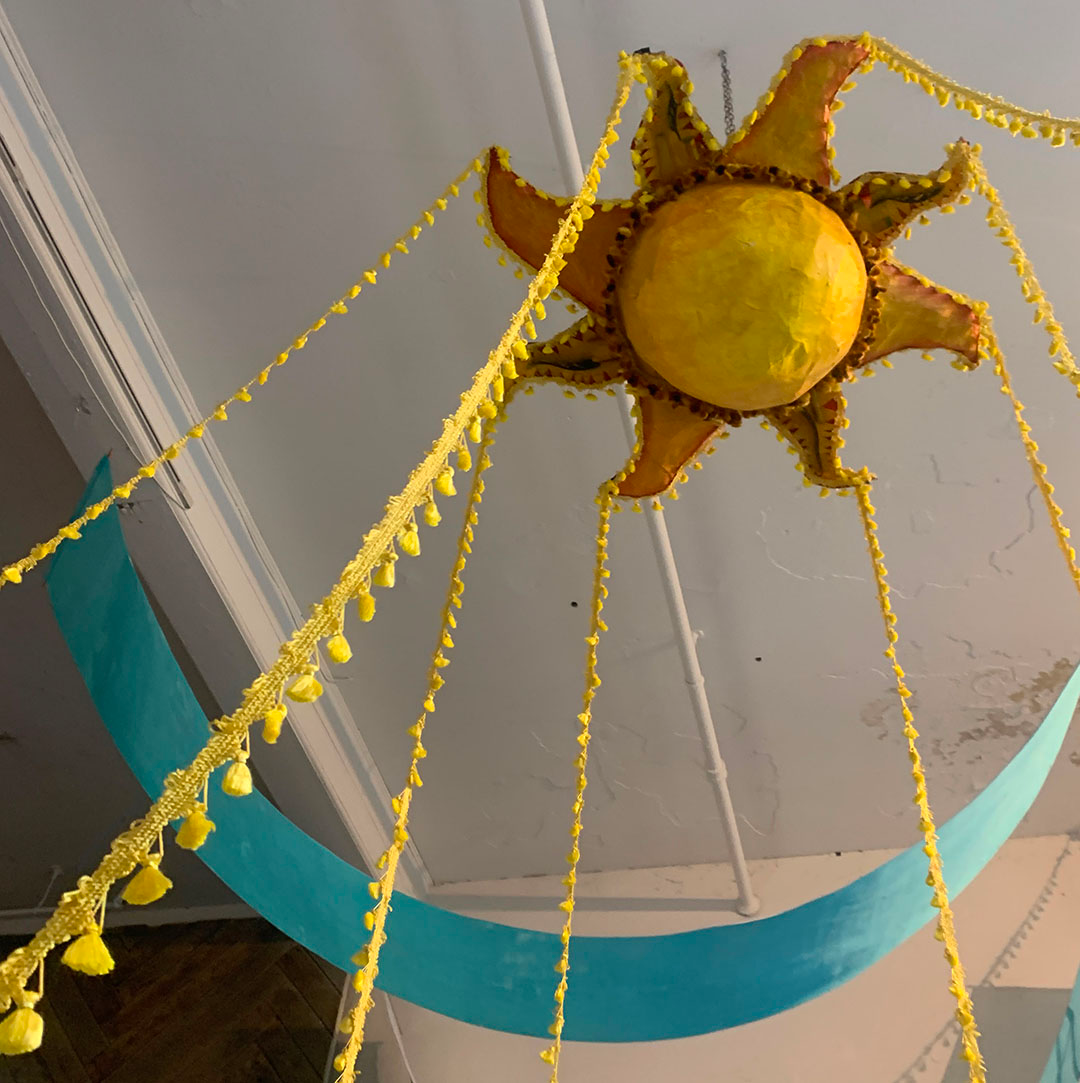
@chiocabreracoz | El Sol | Materials: Paper mache, recycled materials, cardboard, tassels, and painted fabric.
5 Questions
1. In 1994, the economic collapse of the Mexican peso left the country devastated. My parents were young and my mom was pregnant. They knew they wanted the best for their baby, and so they left for the United States full of hope. As a child I struggled to understand how something so arbitrary could change the trajectory of my life and that of thousands of people. My parents came looking for stability, opportunity, and the chance to build a life that felt more secure than the one they were leaving behind. This is something I could understand, especially as I got older and work towards political activism.
2. Being first-generation has made me understand how important it is to have a community that makes things feel like home. I’m in a biracial relationship, and as a new mom, I want to make sure that my son feels connected to all parts of who he is. I want him to know where his family comes from, hear our stories, eat our food, and understand that his identity is something expansive rather than something he has to choose between. I grew up in Humboldt Park and have been enveloped by Mexican and Puerto Rican cultures. Growing up there taught me that culture doesn’t disappear when people migrate. It adapts. It’s dynamic.
I can look at my peers and together we can acknowledge that we’re from somewhere else, or that our families are from somewhere else, and share in the comfort of finding our place in Chicago.
3. Home is a baby shrieking and making pterodactyl noises. I make silly jokes and no one holds it against me. My husband is making delicious food for me and learning guisos from my mother.
I’m making my own traditions and borrowing from everything I encounter. Some traditions come directly from my family, some come from my neighborhood, and some come from the family my husband and I are building together. Home has become less about a place and more about the people I get to share my life with. I carry artisal traditions from Mexico and combine them with puppetry lessons I’ve learned in the East Coast.
4. When I visit my family in Mexico, I feel the distance most strongly. I’m sad that there are so many relationships that I don’t get to nourish in person. I don’t know my grandmother the way I would like to. I don’t know my cousins as deeply as I might have if we had grown up together. I reconcile it by making art, specifically puppetry art. Puppetry art allows me to play in natural and historical spaces. A lot of my work is about community, history, and belonging. I think I’m always trying to understand where I come from and how to share that with other people. I can learn about Mexican history by building a period-accurate scenes and characters. I pretend the characters are my ancestors and imagine how they would have acted. Am I following in their footsteps, even though I am thousands of miles away?
5. The world has to be better for my son. My parents accomplished so much without any support, and if that was possible, then I too can make steps toward my dreams. I want to show everyone my favorite parts of my Mexican culture. I want to create opportunities for families to gather around art the way my family gathered around a table. I want young people to see that their stories are worth telling. I want my son to grow up proud of where he comes from and curious about where other people come from too.
Butterfly Effect: Bridging Borders Exhibiting Artists
Aileen Nicole Castro • Akira – Light that Heals • Alejandra Lemus • Alex Covarrubias – Red Cave • Anna Silvonchik • Arte Duran • Bane.xxa • Christian Joshua Varela Solis • Cindy Uriostegui – Cattco • Cristina Marquez • Elena Diadenko • Elena Pach • EMNI • Gabriel Guzman • Grecia Solorio • Idil Duman • Isaac Galvan • Janis Appleton* • Javier Viñuela*• Kaltra • Kybo • Mariana Perez • Mary Antar • Pamela Rubi Trejo Soria • Peauxline • raqui • Riesling Dong • Rocio “Chio” Cabrera-Coz • Sailee Charlu • Shalala Salamzadeh • Sharvani Rathna Chittem* • Stef Skills • Victoria Park • *Group collaboration