
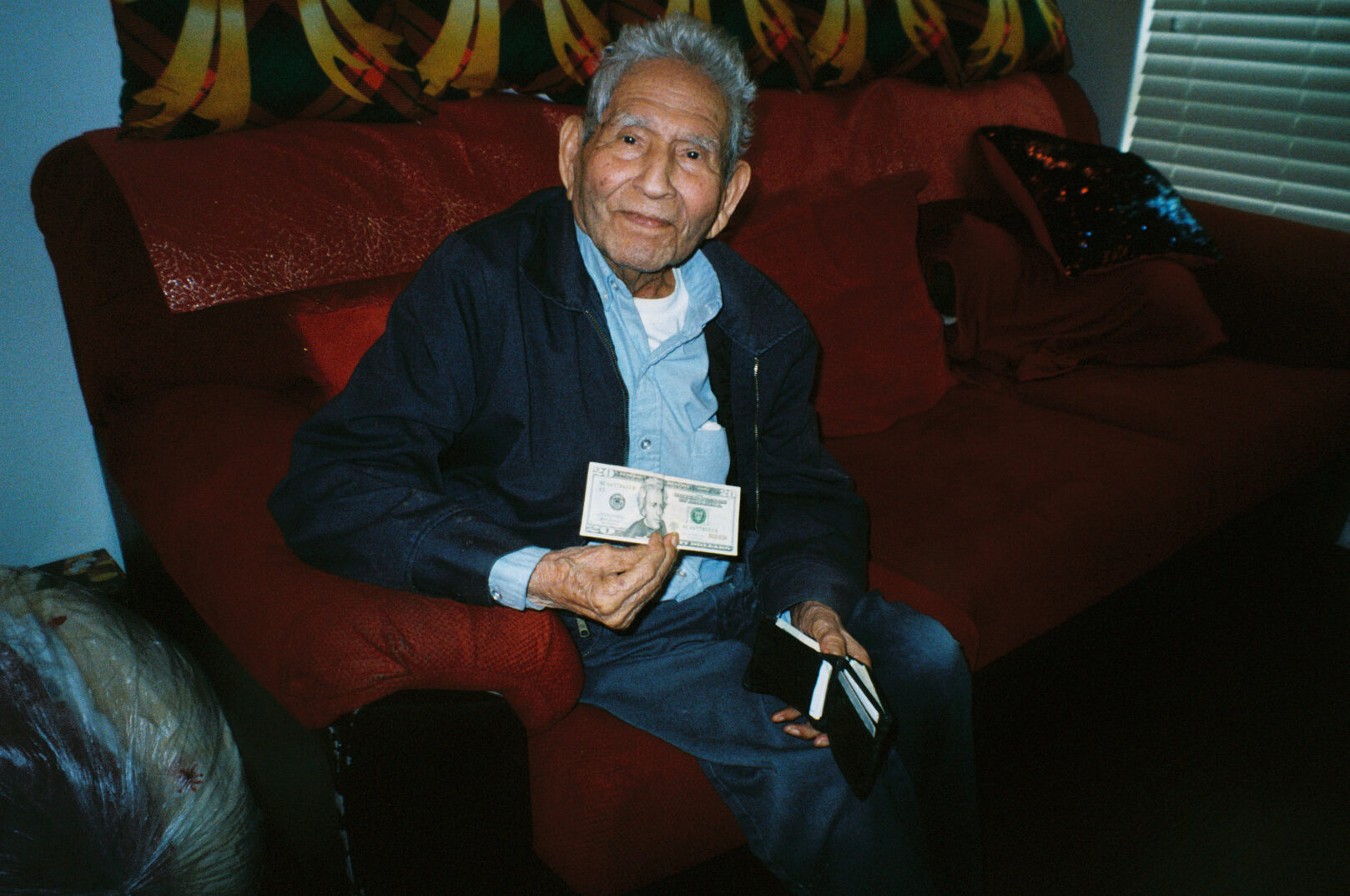
@duckiegabe | Tata Miguel | Chromogenic Print; Dimensions: 11 x 14 in (framed) |


(left) Roman Family Altar in Tijuana | Chromogenic Print; Dimensions: 11 x 14 in (framed) and (right) Nana Maria Luisa echando las Cartas | Chromogenic Print; Dimensions: 11 x 14 in (framed) |
Gabriel Andres Guzmán is a Mexican scholar-artist hailing from San Diego and Tijuana. They received their master’s degree in performance studies at Northwestern University in 2020 and have B.A in English/Media & Cultural Studies/Gender & Sexuality Studies from UC Riverside. Guzmán is currently a PhD candidate in Performance Studies at Northwestern University. Gabriel’s dissertation project looks at how the aesthetic embodiments of race, gender, and sexuality across the lived experiences of communities of color and contemporary artists informs the notion of home, borders, and belonging across the U.S-Mexico borderlands. As a visual artist, they seek to uplift and share the everyday stories of friendship, style narratives, migration, community-building across the LGBTQ+ people of color communities beyond borders and binaries.
5 Questions
1. Mi nombre es Gabriel Andres Guzman y estoy orgullosx de ser parte de una familia de inmigrantes de mi lado patrimonial los Guzman y mi lado matrimonial Roman. La historia del lado de mi papá empieza con el esfuerzo de mi Tata Miguel Guzman que desde los catorce años aprendió a ser carpintero de su abuelo mientras vivían en Durango, MX. De ayi mi Tata Miguel dejó la escuela primaria y su sueño de ser un poeta para dedicarse a la arte del adobe y el cemento, un talento que maestro con sus manos. Durante un proyecto en Mazatlán, mi tata Miguel conoció a mi nana Irma en un baile y fueron inseparables. A los 18 años los dos se casaron y mi abuelo y ella se fueron al norte cerca de la frontera donde mi Tata usó su dinero guardado para comprar un terreno en Tecate. En este terreno, a mano, mi Tata construyó un ranchito, y siguió haciendo proyectos independientes hasta que aprendió sobre una oportunidad con el programa Bracero. Desde 1957-1963, mi Tata laboró en los Estados Unidos y pudo conseguir su visa de trabajo permitiendo la residencia en los EE.UU. Fue con mucho esfuerzo, separación, y sacrificio, que mi Tata Miguel logró ahorrar dinero para comprar una casa en la vecindad Chula Vista, California. El apoyo mutuo entre los dos ayudó que sobresalieron los obstáculos que ya después mi Nana Irma y Tata Miguel lograron a naturalizar como ciudadanos. En esta época mi Nana Irma cuidaba a mi papá y sus tres hijos, y aunque fue muy doloroso de su parte no ver a mi Tata por meses. Las semillas de resiliencia que sembraron mis abuelos me ayudaron aprender y conocer la vida que ellos vivieron para que mi papá pueda tener una mejor vida y educación en los Estados Unidos. Fue por los consejos de mi Nana Irma de nunca dejar la escuela y el apoyo de mi Tata Miguel que pude lograr ser el primero en nuestra familia de obtener mi título de la universidad y sigo luchando para completar mi doctorado.
En el lado de mi mama el asunto de nuestra historia es complicado porque mi Nana Maria Luisa fue adoptada por mi bisabuela Bertha. Ellos tuvieron la oportunidad de mudarse de Tijuana a Los Ángeles después de que se terminó la prepa y mi Nana Bertha se casó con un hombre ciudadano por un tiempo limitado. Mi Nana Maria Luisa fue por la mayoría una mamá soltera que crió a cuatro niños, incluyendo a mi mamá regresando a vivir en Tijuana, Baja California. Mi nana Maria Luisa fue una madre increíble, que se levantaba cada mañana y cruzaba la frontera a las 3 am para dejar a sus niños en la escuela en el otro lado. Yo admiro mucho a mi Nana Maria Luisa porque ella se dedicó a ayudar a otra gente con su don que la ayuda leer cartas y hacer limpias para muchas mujeres y personas de su comunidad en Tijuana y en San Diego. Yo entiendo la historia de ella y mis tías como una experiencia fronteriza que me enseñó mucho sobre la importancia de nunca dejar nuestras raíces y la importancia de ser parte de la comunidad Latina (porque todas ellas me cuidaban de niñx!).
2. The story that surrounds both sides of my family allowed me to immerse myself in a bi-cultural awareness at an early age. Both families maintained numerous photo-albums of which these archives gave me deeper insight into the everyday lives of my parents. I was especially grateful when my Tata Miguel passed down a vintage polaroid he would use to take photos of himself and his surroundings to mail to my Nana Irma as proof that he was surviving the Bracero Program. These foundational stories that make-up my family’s migrational histories were because of the archives that my family kept about life between San Diego y Tijuana. Being able to learn both cities gave me a fuller understanding of the everyday lives that my parents navigated as young people. I have retained friendships and created memories in different places that my parents would frequent as young adults both from nightlife contexts to tienditas to cultural landmarks. Whenever I come home, I am able to visit family and friends in San Diego or TJ and continue exploring our homes together.
With Spanish being my first language, I am grateful I was able to retain it due to my Nana Irma’s urging that I attend a bilingual elementary school nearby her home in Chula Vista, California. My family’s journey to Tijuana and their decision to settle in either San Diego or TJ allowed me to remain connected to my cultural heritage. My Nana Maria Luisa has passed down different curandera practices that have allowed me to support my own chosen family and community members.
3. Currently, I remain strongly connected to my Nana Maria Luisa and my Tias, who have continued to support my higher educational journey. Whenever I go home, I stay with them in our Tijuana home and will enjoy making tamales and pozole together. We also will tend to our large family-altar together which is made up of mixed-media collages and culturally-specific items that we use as a way to honor our ancestors.
Although my Nana Irma passed away when I was much younger, my dad and sister live in her home, so whenever I am visiting San Diego, I am able to feel close to her and to the place I called home as a child. It is because of the women in my family who were storytellers that our cultural traditions and memories were passed down to me. An important part of my Nana Irma’s caretaking was the chili-tree she planted that we continue to take care of. My dad has continued to teach us my Nana’s home cooked meals that involve dishes like milanesa y chilaquiles.
As a film photographer and researcher, I have found it rewarding to connect my scholarly-artistic practice with home. Inspired by my family photo-albums, I have created an entire photographic series about the everyday lives of my chosen family members who reside in either Tijuana or San Diego. I have also collaborated with my family members on both sides of the family to document different aspects of their life as a means of preserving our tradition of maintaining physical media and archives in the form of family photographs. I am grateful to have been able to curate a solo-show dedicated to highlighting these physical archives and my photo-project in 2024 as well as creating an altar as part of a group exhibition with my youngest cousins (my Tia’s children) at a gallery near the Tijuana border while we were grieving a loss on my mom’s side.
4. It has been difficult being away from home as long as I have been, especially after moving to Chicago for grad school in 2019. I miss being close to the water which is why I lived near Lake Michigan for the longest time. I found myself talking to my Nana Maria Luisa and my tias on the phone those first years I lived here, where they encouraged me to cultivate my relationship with water by performing rituals they have done before. Although I have developed my own relationship with queer and Latine community members here in Chicago through my professional and artistic pursuits, I miss the flavors from back home. I have found an appreciation for Mexican food here in Chicago but remain unsatisfied compared to what I grew up having in Tijuana.
Throughout my journey at Northwestern, I have also found it difficult to translate my community-based research in academic spaces as I draw from both my cultural upbringing in how I actively choose to tell stories about the U.S-Mexico borderlands. At times, it feels like that negotiation between myself y mis comunidades y como entendemos la frontera gets lost in the narrow perspectives that others have about the U.S-Mexico borderlands. I am able to retain that fullness by keeping some things about my spiritual and artistic practices private rather than sharing-out too many details, as a means of not only protecting these sacred details but also as a reminder that not everything is meant to be shared. When I am away from home, I find comfort being near a body of water or when I am taking photos at queer nightlife events, I am reminded of the lessons my family passed about home y sus querencias, about finding joy and comfort in these everyday moments of familiarity.
5. Pensando en esta pregunta me recuerda cuando mi nana Bertha’s me dijo que algún día quería que yo fuera su doctorcito. Ahora, estoy preparándome para completar mi último año de mi doctorado en Performance Studies en la Universidad Northwestern. La esperanza que tengo está heredada de la resiliencia de mis familiares que logran hacer un cambio generacional cuando cruzaron la frontera. Y lo mismo siento sobre mis comunidades cuir y trans que me apoyaron cuando mis padres me rechazaron al inicio por mi sexualidad y género. Mis reflexiones sobre los sueños que cumplieron mis familiares de San Diego y Tijuana siempre han sido mi razón porque sigo echándole ganas aunque la vida se ponga pesada. La manera de que mis abuelos lucharon para llegar a los Estados Unidos para darnos una mejor vida era un ejemplo de la manera en que la semilla llega a sembrar sus raíces. Las mujeres que criaron mis padres y me cuidaron a mi desde pequeño han sido mi ejemplo a seguir porque ellas no rechazan o temen a la diferencia o disidencia. Ellos me mantienen conectado de donde vengo y siempre estarán a mi lado en mi largo camino. Mi sueño es ser un Profesor en Humanidades y dar clases sobre la cultura e historia Latina. Espero no nomas ser un académico sino un artiste-escolar que practica fotógrafo análogo para mantener las tradiciones de mi familia a las futuras generaciones de estudiantes. Yo dedico mis sueños a mis ancestros y más que nada a las madres (both biological and chosen) que me dieron su bendición para perseguir mis sueños.
Butterfly Effect: Bridging Borders Exhibiting Artists
Aileen Nicole Castro • Akira – Light that Heals • Alejandra Lemus • Alex Covarrubias – Red Cave • Anna Silvonchik • Arte Duran • Bane.xxa • Christian Joshua Varela Solis • Cindy Uriostegui – Cattco • Cristina Marquez • Elena Diadenko • Elena Pach • EMNI • Gabriel Guzman • Grecia Solorio • Idil Duman • Isaac Galvan • Janis Appleton* • Javier Viñuela*• Kaltra • Kybo • Mariana Perez • Mary Antar • Pamela Rubi Trejo Soria • Peauxline • raqui • Riesling Dong • Rocio “Chio” Cabrera-Coz • Sailee Charlu • Shalala Salamzadeh • Sharvani Rathna Chittem* • Stef Skills • Victoria Park • *Group collaboration