
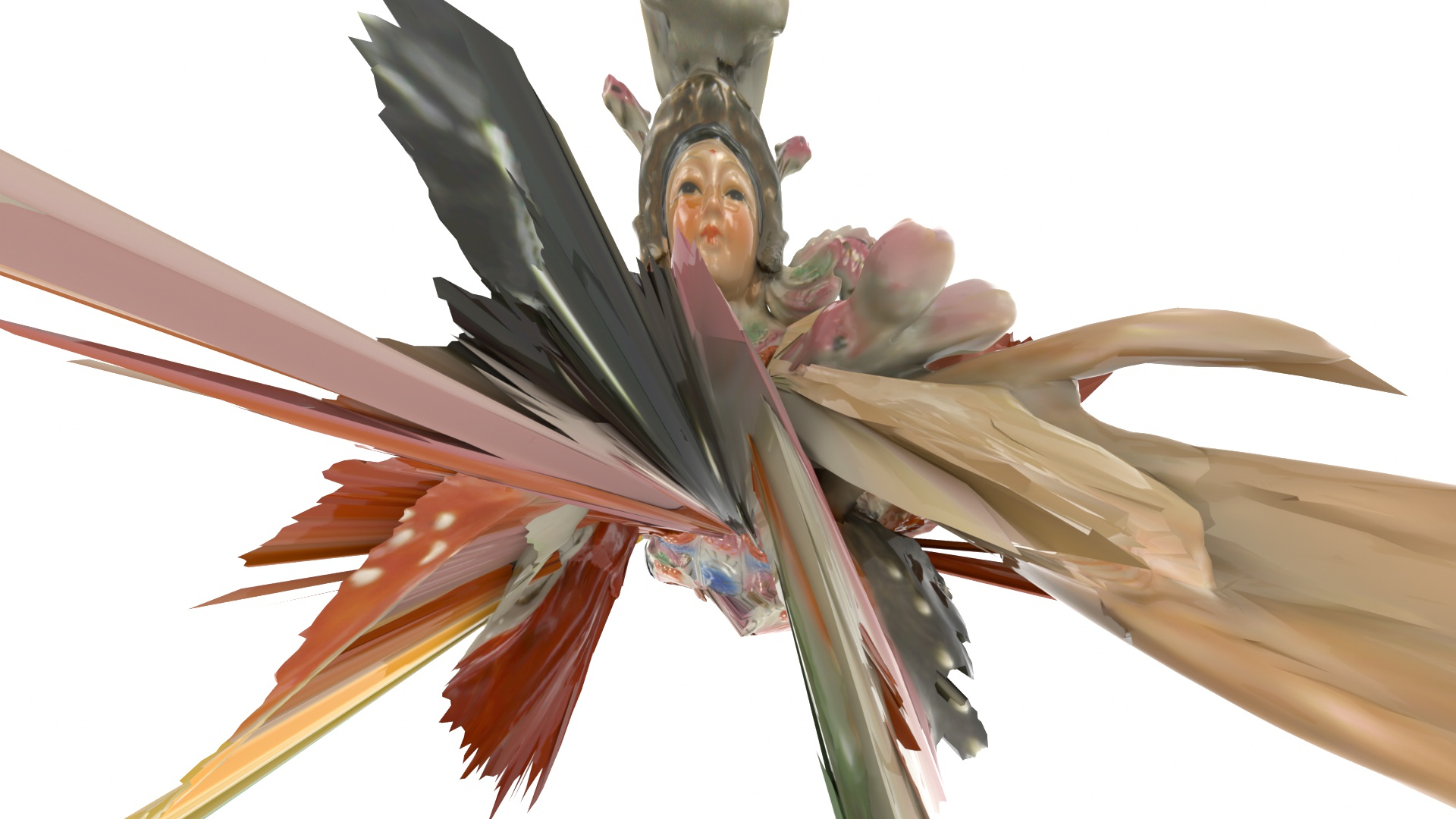
@calayahcore • www.calayah.org • 2024, Digital Performance •
5 Questions:
1. As a Chinese international student, my journey to the US is less a linear migration and more a shift in identity. Studying abroad places me in a permanent in-between state: never fully inside, never entirely outside. My “foreignness” is constantly produced through language, accent, visa status, and cultural expectations. The driving reason for this journey is not only education, but the need to gain distance—from familiar narratives, from inherited social roles, and from fixed ideas of belonging. In the US, I experience both opportunity and constraint, where visibility and marginalization coexist, shaping how I understand power, identity, and selfhood.
2. My immigration experience has reshaped my relationship with both my family and my community into something more dispersed and less stable. Physical distance has weakened everyday intimacy, but it has also made our connections more intentional and reflective. With my family, care is often expressed through absence, delayed conversations, and unspoken concern rather than daily presence. My community now feels fragmented and mobile—formed through shared foreignness, temporary belonging, and mutual recognition among other migrants. It is not rooted in place, but in experience. It feels fragile yet supportive, marked by empathy, distance, and a constant negotiation of identity across borders.
3. My relationship to home and tradition has shifted from familiarity to critical distance. Home is no longer a fixed place, but a layered memory shaped by language, rituals, and inherited expectations. Living abroad has loosened tradition’s authority: practices that once felt natural now appear constructed, gendered, and political. At the same time, distance has made certain traditions more fragile and intimate, something I choose to carry rather than automatically inhabit. Home now feels partial and mobile—less about return, more about how I negotiate belonging, care, and identity across different cultural and ideological spaces.
4. I feel the pull most strongly in moments of decision and vulnerability—when I have to choose how to speak, what values to defend, or how to imagine my future. These moments expose the gap between inherited expectations and the life I am building now. The tension intensifies during family conversations, cultural rituals, or encounters with authority, where older frameworks quietly resurface. I reconcile these feelings not by resolving them, but by holding them in parallel. I accept contradiction as a condition of migration, allowing friction between past and present to become a space for reflection rather than a demand for coherence.
5. My hope is centered on creating space—intellectual, artistic, and bodily—where complexity is allowed to exist without simplification. I am building dreams that are not about stability in the traditional sense, but about agency: the ability to speak in my own voice, to question inherited structures, and to transform tension into form. Through research and artistic practice, I hope to make visible the forces that shape identity, gender, and power, especially for those who live between cultures. Rather than aiming for arrival or resolution, my dream is to sustain movement, curiosity, and ethical responsibility in an uncertain world.
___
Bio | Art Statement
Calayah (b. 2000, China) is a London-based digital performance artist and curator. She holds an MA in Art from the Royal College of Art (2024) and a BA from Beijing Normal University (2023). In 2024, she was a visiting tutor in BA Fine Art at the University of Westminster. Her work has been shown in group exhibitions at Tate Modern and Tate Britain.
Calayah’s work challenges societal norms, inviting viewers to critically examine how gender, libido, and the body are influenced by various ideologies. Her critical lens ranges from clinics implanting prosthetic phalluses for women to cultural industries catering to virtual attachments, from AI churches worshiping science to the commercialization of life through body modifications. Her practice interrogates synthetic, moldable, and imitable identities, alongside their generation and regeneration.
Calayah thrives on creating intense tension in her works, presenting an excess that provokes a visceral reaction akin to overindulgence in sweets leading to nausea. Through this aesthetic of excess, she constructs a beautiful yet violently compelling new world. Her works seductively draw viewers in, posing the tantalizing question: will you take a bite?
______
Featured Artists | Akira – Light that Heals • Alejandra Lemus • Angie Zaveleta • Anna Silivonchik • Bane-xxa • Calayah • Catherine Economopoulos • Christian Joshua Varela Solis • Cindy Uriostegui • Darth Rudo • El Poeta • Grecia Solorio • Idil Duman • Javier Viñuela • Jimena Hernández Aguilar • Julia Obrien • Kaltra • Kybo • Lorena Salinas • Lydia Gunn • Mariana Perez • Mary Antar • Michael Azpeitia • Papaya Guayaba • Peauxline • Rita Garcia Šindelář • Roele Phantom • santi[ago alvarado] • Schantelle Alonzo “Mishipiku” • Scribe • Tai Kojro-Badziak • Toni Maugeri • Valeria Osornio • Victoria Park • Victoria-Riza • Yekseny Guerrero