
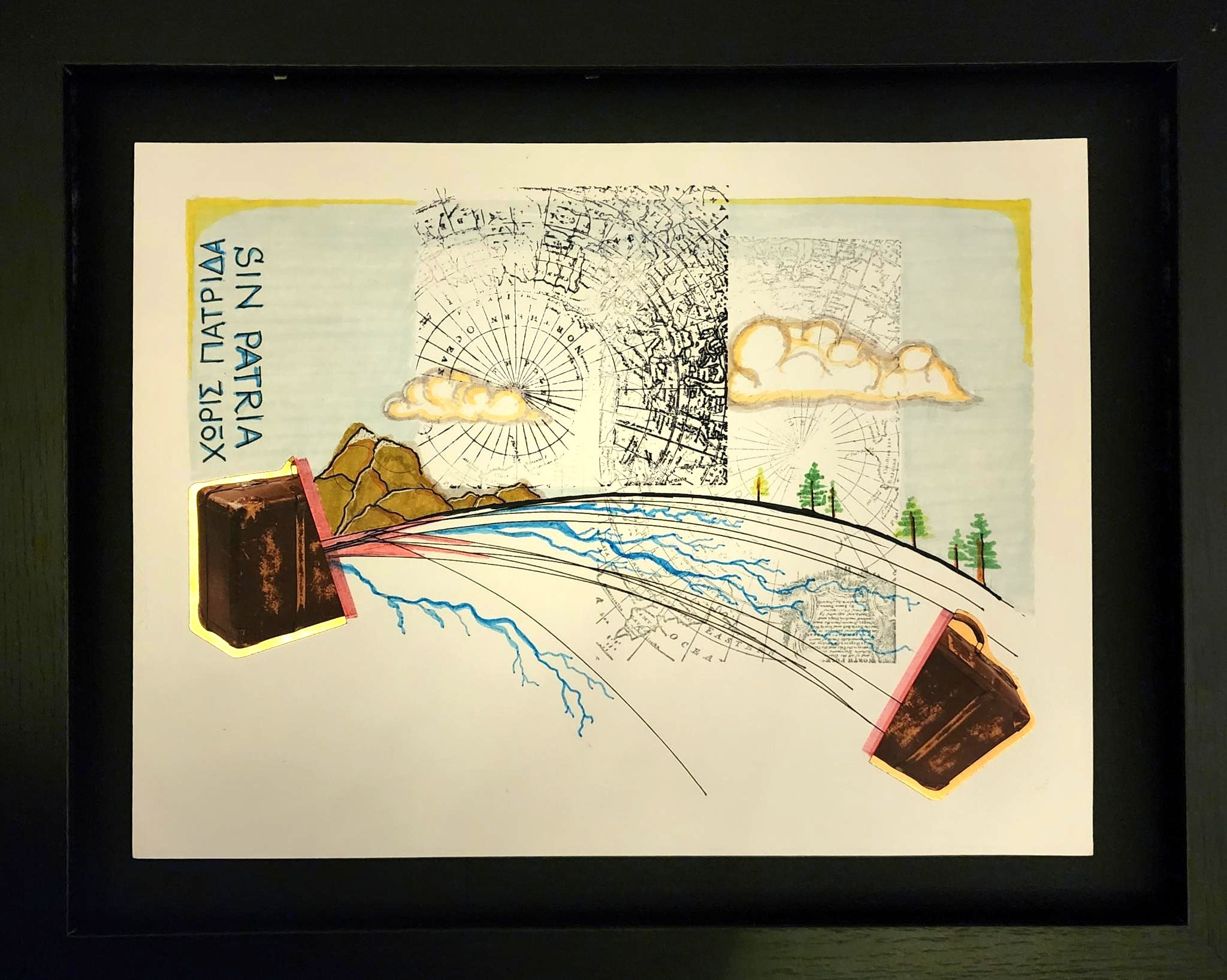
@def_not_cath • Pero Sin Amo, Mixed Media on Paper •
5 Questions:
1. My parents came to the US to pursue education. My father came in his twenties, and my mother came with her family, as a child. They met here, in Chicago. My mother’s family had attempted to immigrate three times before becoming established. Even then, they lived in extreme poverty, typical of the Reagan era. My mother was the first woman in her bloodline to become educated. Her mother, who raised me, had only briefly attended second grade. My parents’ search for education was fruitful, and even in such a common story, was a deeply-felt beacon of hope in this journey of my own.
2. The Hellenic community in Chicago is small and ever-shrinking. I grew up strongly rooted in the Church and Greek-speaking community, going to baptisms, weddings, parties, events year-round. But as I aged, it seemed that the last generation of true Diaspora Greeks were growing disinterested in not only their community, but also their language, their motherland, and its traditions. My fluency in my mother tongue was unusual; my peers in the community spoke broken Greek and it put up a wall between us. Even within my family, it seems my younger brother and cousins have some disparities in their own identities and have let their Greek fall to the wayside. Yet, my family is still a tight-knit one — I was raised in a multi-generational home, and although most of my relatives are still in Greece, lines of communication are ever-present and grow stronger as I age.
3. As a child, I resented the notion of tradition. I saw it as inextricably tied to religion, to responsibility, and to femininity. I resented the family model that told me, a child, that I was responsible for caretaking. Being the eldest daughter, I fell down a path that parentified me, and so for many years I was trapped between avoidance and rebellion of anything I perceived to be related to tradition or homemaking. After a complicated move at eighteen (I went abroad to pursue an education of my own), I started to build perspective and got the space necessary to process my formative years. Since then, I am continuously reshaping my understandings of self as related to other, and I have built a deep reverence for the idea of home and all the traditions within it.
4. My mother’s lineage is from a tiny village in rural mainland Greece. Up until fifty years ago, my ancestral line was largely mountain pastoralists. We were, for all intents and purposes, indigenous to this area of Greece. In that region, my foremothers survived war, famine, enslavement by Ottoman Turks, and more. They were without education, without work, without oversight. It’s impossible to understand how life could change so much in so little time. I have moments of intense imposter syndrome as I move towards a professional career and a master’s degree. I believe strongly that some of the things I struggle the most with are a product of the role models and habits I was taught as a small child – my grandparents brought the village with them, so to speak, and did not necessarily adapt well to the demands of the western world.
When I feel most out of place, I gain a lot of solace in identifying and focusing on the many vivid traits that I did receive from my family: tremendous strength of will, exceptional emotional intelligence, maternal warmth (which I’m still learning to embrace), and attunement to the earth and the world around me.
5. My dream is one of collective living. I saw for many years the despair that was borne of the western focus on individualism and self-reliance, and still could not understand why everything felt so lonely. As I came of age and built my own community, I saw the radical change that could come from something as simple as the age-old tenets of trust, empathy, and taking joy in one another. I have made a commitment to questioning the demands of life in the west, and replacing each one with something that brings me closer to what my life might have been if I’d gone back to Greece to stay. It gives me joy to bring the village to my own neighborhood – this time abandoning the outdated traditions of the old world – inviting instead all the things that sustained and nourished my loved ones. I am filled with hope when I find ways to rely on the land and give back to it. I am filled with hope when I meet someone with whom I can commune and share my thoughts and skills. I am filled with hope, most of all, when I look around and realize that I’ve built a good life, as it was imagined for me, in my grandmother’s beautiful dream.
___
Bio | Art Statement
Catherine Economopoulos is a Hellenic multidisciplinary creative whose work centers around trauma, the architectural discipline, and healing through mutual aid and collective liberation, among other themes. Based in Athens/Chicago/Toronto, Catherine’s practice is deeply rooted in community; to connect or learn more, check out economopoulos.net.
___

Being Followed, Digital Illustration
______
Featured Artists | Akira – Light that Heals • Alejandra Lemus • Angie Zaveleta • Anna Silivonchik • Bane-xxa • Calayah • Catherine Economopoulos • Christian Joshua Varela Solis • Cindy Uriostegui • Darth Rudo • El Poeta • Grecia Solorio • Idil Duman • Javier Viñuela • Jimena Hernández Aguilar • Julia Obrien • Kaltra • Kybo • Lorena Salinas • Lydia Gunn • Mariana Perez • Mary Antar • Michael Azpeitia • Papaya Guayaba • Peauxline • Rita Garcia Šindelář • Roele Phantom • santi[ago alvarado] • Schantelle Alonzo “Mishipiku” • Scribe • Tai Kojro-Badziak • Toni Maugeri • Valeria Osornio • Victoria Park • Victoria-Riza • Yekseny Guerrero