
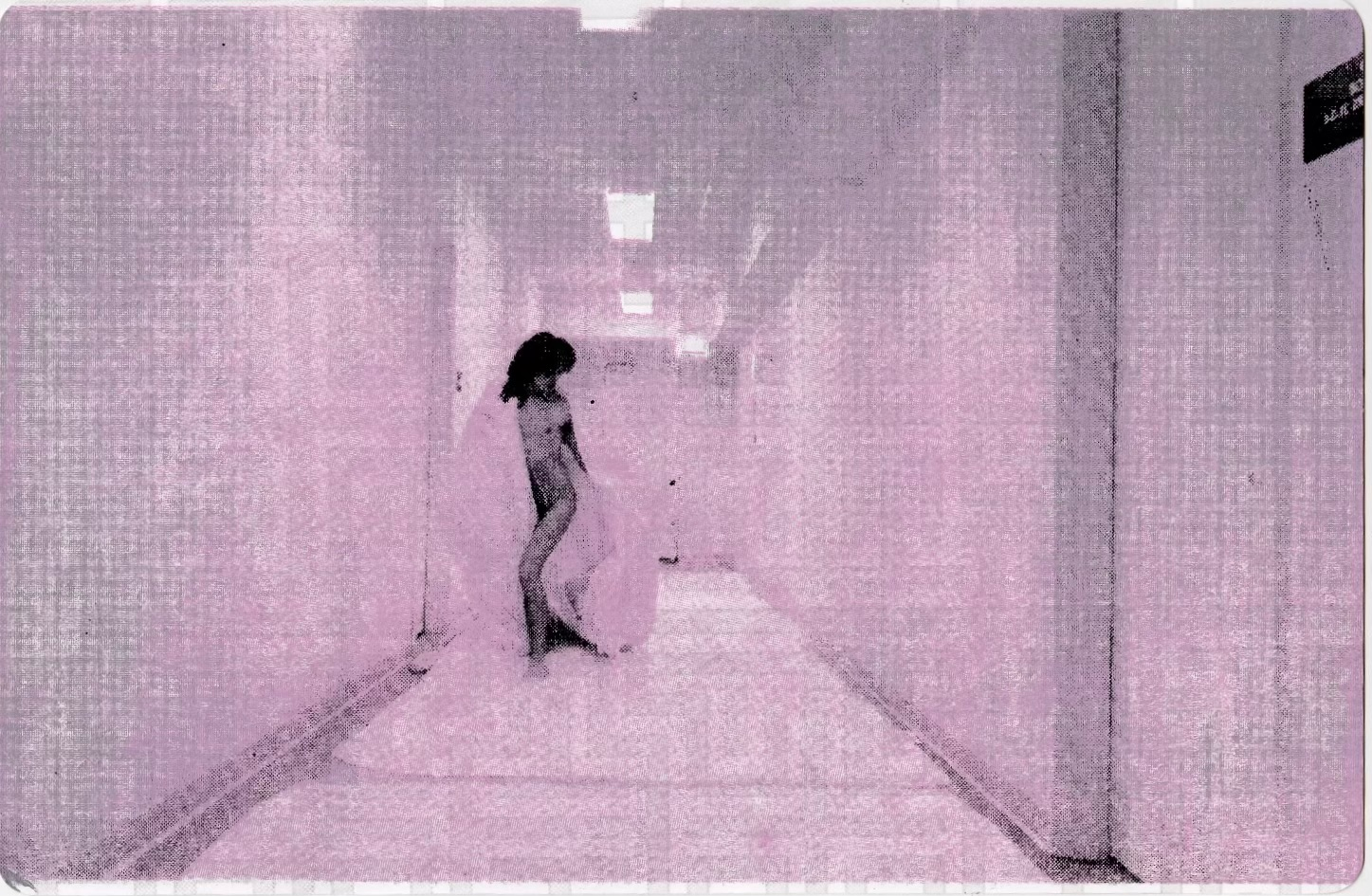
@christian_varela___ • FEELING GREAT AGAIN, 2026. print •
5 Questions:
1. My family’s journey to the United States is rooted in a pursuit of survival, stability, and new possibilities. My maternal grandparents were born and raised in Zacatecas, Mexico, and immigrated to the U.S. in the late 1960s in search of higher wages and greater opportunity for their future children. Their lives in the U.S. were defined by hard, often invisible labor—my grandmother worked across domestic, factory, and retail jobs, while my grandfather held trade based positions and later worked as a pace driver. Their sacrifices built the foundation that allowed the next generations of my family to exist and grow here.
My father’s journey carries a more difficult and precarious weight. Born and raised in Durango, Mexico, he attempted to cross the border multiple times and was deported three times. Despite these traumatic events, he persisted, driven by a similar desire, to find a life with less suffrage and to create a future rooted in possibility. In 2002, my parents met and quickly built a life together, having two children—my sister, Miranda, and myself. In 2016, my father was permanently deported, without the opportunity to return.
2. Growing up in the secluded countryside of Illinois, my understanding of family and community was often disorienting and fragmented. I attended predominantly white public schools where both the curriculum and the culture centered whiteness. Most of my friends were white, and the few Latinx students I encountered often felt distanced and or ashamed of their heritage. Within this environment my own sense of identity became distorted. I internalized these surroundings so deeply that I whole heartly believed I was white myself, until I was first called “beaner” in the 5th grade.
When my father was deported I was 11, only further complicating my relationship to family. Our relationship is complex and difficult to articulate, not only by physical separation but by differences in values, ideologies, and lived experiences. He is no longer part of my life, my understanding of his side remains limited, held mainly through fragmented but meaningful childhood memories.
Although his absence left an irreversible impact, at the same time, this rupture has instilled in me a deep desire to reconnect with what feels distant or obscured. I carry the weight of separation and the courage of determination to rekindle what was left behind. This tension has become a driving force in my practice and livelihood, pushing me to question, research, and reclaim my cultural inheritance on my own terms.
Since attending the School of the Art Institute of Chicago, I have found a community that is extremely supportive, expansive, and affirming. While the path to get here was one I navigated alone, it has given me a more intentional and sincere relationship to my heritage. My understanding of family and community is no longer something I passively inherit, it is something I actively nurture, question, and surge.
3. Currently, my relationship to home is in constant flux. Growing up in a perpetual cycle of moving, alongside the absence of my father, leaving my sense of home feeling unrooted. I’m less tied to a physical place and more defined by transition. Home, for me, has become something I am still searching for rather than something I can clearly return to.
This instability is further complicated by the tension between my identity and my family’s values. My queerness, along with my beliefs and ideologies, often contrast to those within my family. Communication can be difficult, at times resulting in conflict and distance. Despite this we remain cordial and continue to gather and celebrate traditions together. These traditions and gatherings however feel different now, quieter, strained, and tainted. There is a noticeable absence of pride and cohesion. I have a sense of responsibility, not only for myself, but for the younger members of my family to question the assumptions we have inherited and to actively rebuild our relationship to culture, tradition, and each other. My understanding of home is shifting from something inherited to something I must make intentional.
4. The pull between my present life and my roots is something I experience constantly, both in my practice and in my personal life. My work is deeply tied to where and who I come from, and because of this I have developed an awareness that has given me great confidence. It is, however, more complicated when my work is presented to audiences who are not Latinx. In those moments, I feel a gap between what I am expressing and what is being understood. In these times I feel as though the depth of my experiences, and the specificity of my work are not fully received. This disconnect can be frustrating and isolating. However, I have come to recognize that not every experience is meant to be understood and that there is a resistance within cultural work that cannot always be translated. Rather than seeing this as a failure I have tried to embrace it. I find a sense of grounding in knowing that my work remains rooted in truth, regardless of how it is interpreted. I hope to approach the viewers of my work with openness while allowing them to have their respected space for dialogue, curiosity, and connection. In this space of tension, I foster new growth and knowledge throughout my practice.
5. I center a faith consuming hope in my practice that resists the idea of art as something hierarchical or reserved for the “elite”. I feel a great responsibility to use my work in ways that extend beyond myself. Whether through bringing visibility to stories that are often overlooked, offering new perspectives, creating moments of joy, or simply allowing people to feel seen and connected, I believe art has the capacity to hold all of these things at once. I want my work to reach people not just intellectually, but emotionally and physically. I want to foster a practice that is continuously growing, one that embraces collaboration and remains responsive to the communities it exists within. More than anything, I hope to create work that gives back and contributes to something larger than myself, to be part of a creative ecosystem that is grounded in care, connection, and shared experience.
___
Bio | Art Statement
I am a Mexican-American queer and gender nonconforming artist born and raised in Chicago Illinois. My practice explores the consequences of colonization in contemporary Latin American culture, the sensitivity of my environment, and the dynamics of personal relationships. Through a visual investigation of aesthetics, cultural survival, deterritorialization, and inheritance, I examine how history continues to shape identity and material culture. My choice of materials is rooted in the world of my work, allowing them to serve as memory and language. At the core of my practice is an ongoing interrogation of my own position within the systems of colonization, seeking personal and cultural agency through syncretism—not as mere adaptation, but as an act of resistance.
______
Featured Artists | Akira – Light that Heals • Alejandra Lemus • Angie Zaveleta • Anna Silivonchik • Bane-xxa • Calayah • Catherine Economopoulos • Christian Joshua Varela Solis • Cindy Uriostegui • Darth Rudo • El Poeta • Grecia Solorio • Idil Duman • Javier Viñuela • Jimena Hernández Aguilar • Julia Obrien • Kaltra • Kybo • Lorena Salinas • Lydia Gunn • Mariana Perez • Mary Antar • Michael Azpeitia • Papaya Guayaba • Peauxline • Rita Garcia Šindelář • Roele Phantom • santi[ago alvarado] • Schantelle Alonzo “Mishipiku” • Scribe • Tai Kojro-Badziak • Toni Maugeri • Valeria Osornio • Victoria Park • Victoria-Riza • Yekseny Guerrero