
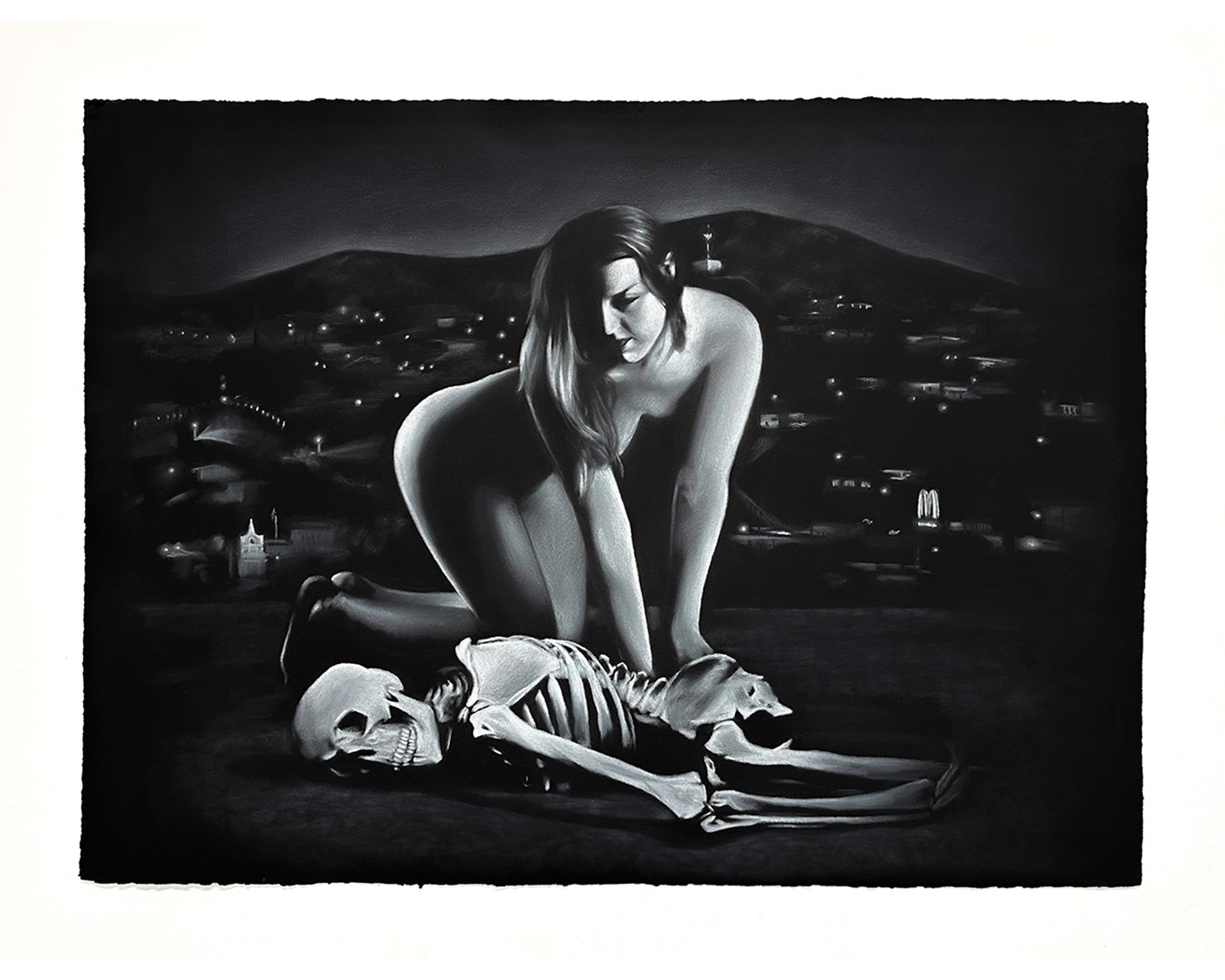
@gsolorioart • HOY VOY A CAMBIAR, White charcoal on paper •
5 Questions:
Grecia Solorio
“Ambos Nogales”: Nogales, Arizona, USA/Nogales, Sonora, Mexico
1. My mother was born and raised in Nogales, Sonora, Mexico, while my father grew up in Mexico City. Because my mother was raised on the border, the United States was always physically close, Nogales, Arizona was only a short walk from her childhood home. Though she occasionally crossed the border for leisure, she remained rooted on the Mexican side of Ambos Nogales. My father, however, attempted to cross the border as a teenager in search of opportunity. He successfully entered the United States but was detained by Border Patrol shortly after arriving on a trail.
After this experience, my father realized that the only way to support his family and move forward was through education. Determined to achieve his lifelong dream of becoming a doctor, he dedicated himself to his studies. Years later, he returned to the border, this time to Ambos Nogales, as a physician/surgeon and established his practice in Nogales, Sonora. It was there that he met my mother and where they eventually married. After living for many years at the Arizona border, my father later passed his American citizenship test and my mother obtained permanent residency. I was born a U.S. citizen in Nogales, Arizona, though I spent the first years of my childhood living in Nogales, Sonora before my family settled in Nogales, Arizona, so I could begin my education in the American school system.
2. Now living in Chicago, both of my parents’ homes feel far away. My mother’s family remains in Nogales, Sonora, while my father’s family lives in Mexico City. Growing up in Nogales, Arizona meant living in a community that is deeply intertwined with Nogales, Sonora. The two cities function almost as one, despite the physical border between them. Even as the border wall has become more fortified and lined with barbed wire, the Mexican influence remains inseparable from everyday life in Nogales, Arizona. Our community reflects this shared identity, one that exists on both sides of the border and cannot be easily separated by political boundaries.
3. Although I was raised in the border environment of Nogales, my teenage years gradually became preparation for leaving. I always knew I would eventually move to a larger city in pursuit of broader opportunities. Having lived in Chicago for three years, my body longs for the border; it yearns for the ghosts of the past that roam Morley Ave and the Deconcini Port of Entry. At the same time, I recognize that my ambitions had begun to outgrow the limits of Ambos Nogales. My relationship to home has therefore become more reflective, the distance has made me appreciate its influence on who I am and on the work I create.
4. I feel the pull most strongly in small moments: when I hear my mother’s voice on the phone, when I eat a meal without Sonoran flour tortillas, or when I realize that the border is no longer five minutes away but instead requires a flight and a long drive. Mexico once felt inseparably close, and now I feel the distance more sharply. To reconnect with that sense of closeness, I listen to Jenni Rivera—my mother’s favorite—and imagine the warmth of the Arizona sun on my skin. When I return to Nogales, I try to absorb as much as possible before leaving again. Most importantly, I carry the essence of Ambos Nogales into the work I create, allowing it to breathe implicitly through my drawings.
5. My hope lies in seeing my hometown of Nogales evolve and expand beyond the narratives that often define it. For too long, it has been portrayed primarily through the lens of border politics, rather than as a place birthing the next generation of artists. My dreams exist outside of Ambos Nogales, but they remain deeply connected to it: dreams of creating without limits, creating irreverently but deliberately. Ultimately, I hope to contribute to a future where Ambos Nogales is known not only for the border wall that divides it, but also for the artists and culture that emerge from it.
___
Bio | Art Statement
I make figurative works on paper that explore—with a combination of criticality and devotion—themes of love, passion, vulnerability, and faith. My primary focus is to create intimate-sized portraits, mostly of female figures, using traditional dry media such as soft pastel, charcoal, and graphite. I am endlessly moved by the intensity and dramatic essence of European Baroque artists such as Caravaggio and Gian Lorenzo Bernini, and am aligned with contemporary artists, such as Vincent Valdez, whose masterful yet unafraid embodiment of the human figure unearths truths that are often avoided. Through these influences, I examine the complexity of the human experience from a feminine perspective, offering space for often hidden emotions, such as those of longing, eros, fragility, and uncertainty. By making them visible, my work affirms that these vulnerable truths exist among every soul, and it is essential to remain connected to these states of being.
______
Featured Artists | Akira – Light that Heals • Alejandra Lemus • Angie Zaveleta • Anna Silivonchik • Bane-xxa • Calayah • Catherine Economopoulos • Christian Joshua Varela Solis • Cindy Uriostegui • Darth Rudo • El Poeta • Grecia Solorio • Idil Duman • Javier Viñuela • Jimena Hernández Aguilar • Julia Obrien • Kaltra • Kybo • Lorena Salinas • Lydia Gunn • Mariana Perez • Mary Antar • Michael Azpeitia • Papaya Guayaba • Peauxline • Rita Garcia Šindelář • Roele Phantom • santi[ago alvarado] • Schantelle Alonzo “Mishipiku” • Scribe • Tai Kojro-Badziak • Toni Maugeri • Valeria Osornio • Victoria Park • Victoria-Riza • Yekseny Guerrero