
@niduman • idilduman.com •
5 Questions:
1. I did technically have a non-immigrant start to my journey to Chicago. I came here as an international student upon getting accepted to SAIC with a scholarship in 2018, and the situation in both my home country and the States have escalated in a way neither me or my family could foresee. Turkey did become exponentially more violently queer-phobic every year, elected oppositions officials started getting arrested like it’s nothing, and the middle class almost shrunk to non-existence due to insane inflation rates since 2018 until now. I know all places have their hardships, don’t get me wrong; but I felt a sense of safety in Chicago through the community I found here.
2. I’ve always been the independent oldest daughter of the family, but it doesn’t take away the guilt of missing out on being there for my younger siblings as they grew up. Most of my work references a place, an object, or a symbol from home; but the whole time I try to re-enact the feeling of togetherness with my mother and siblings when I was back in my hometown.
3. I thought I didn’t grow up in a traditional family until I became unable to leave the States due to my status change. I was left to be responsible for my own Nevruz, Eid, new years, Hidrellez traditions; and suddenly I was realizing how much of a privilege it was to have community elders pulling most of the emotional labor to make magic happen.
4. It’s Nevruz time as I type this, and as spring arrives, the smell of “cemre” (radiation of heat falling from sun to air) is what makes me feel home wherever I am. I remind myself that next year I want people who will jump over fire with me.
5. I find this question very tough to answer. Hope is a fleeting feeling these days. I don’t know how to dissect or control her; I just cherish her when she decides to say hi.
___
Bio | Art Statement
Idil Duman (she/they), object designer and artist from Turkey, plays with mechanics of functionality and fluidity of sentiment in her work. Using her education and practice as a furniture designer and her personal research on Turkic nomadism, Duman experiments with adding and removing utility from objects, aiming to test the limits of user interaction and invoking collective emotion.
Crafting objects heavily loaded with queer and ethnographic undertones, Duman creates and portrays an experience between the inanimate body of the object and the living body of the audience.
___
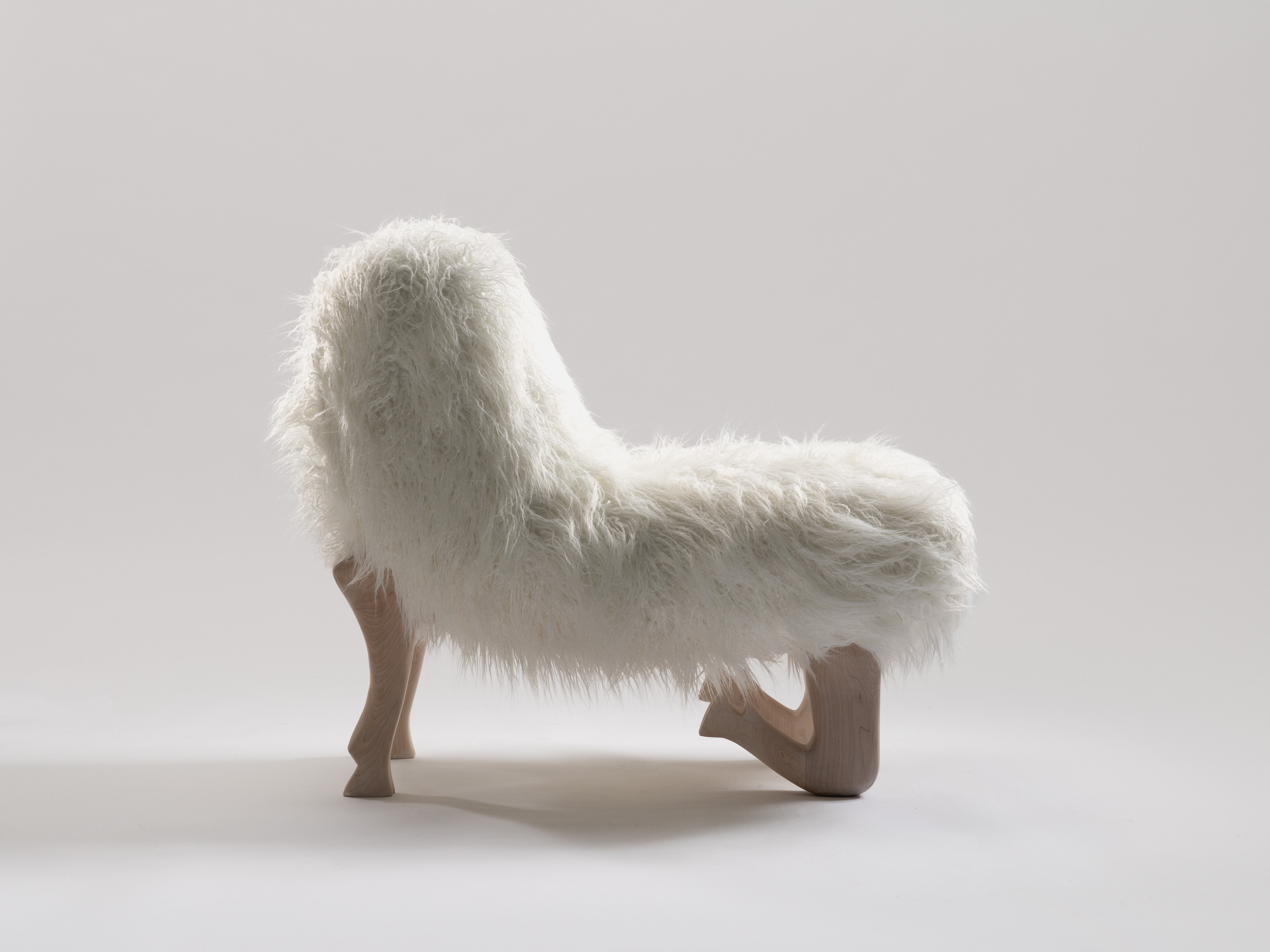
Kneeling Sheep Chair, Hand-carved soft maple, faux sheep fur.
Coming out of the need for a comfortable embrace that reminds me of my pastoral hometown and the sheep my family used to raise, I came up with the Kneeling Sheep Chair. I transformed the vulnerable anatomy of a lamb kneeling to drink milk from the mother into a seat form. I aimed to capture the dichotomy of the comfort mother’s embrace and the vulnerability of homesickness in one chair. This object creates a personal cocoon for me, warping a comfort animal from home into a utilitarian safe space.
______
Featured Artists | Akira – Light that Heals • Alejandra Lemus • Angie Zaveleta • Anna Silivonchik • Bane-xxa • Calayah • Catherine Economopoulos • Christian Joshua Varela Solis • Cindy Uriostegui • Darth Rudo • El Poeta • Grecia Solorio • Idil Duman • Javier Viñuela • Jimena Hernández Aguilar • Julia Obrien • Kaltra • Kybo • Lorena Salinas • Lydia Gunn • Mariana Perez • Mary Antar • Michael Azpeitia • Papaya Guayaba • Peauxline • Rita Garcia Šindelář • Roele Phantom • santi[ago alvarado] • Schantelle Alonzo “Mishipiku” • Scribe • Tai Kojro-Badziak • Toni Maugeri • Valeria Osornio • Victoria Park • Victoria-Riza • Yekseny Guerrero