
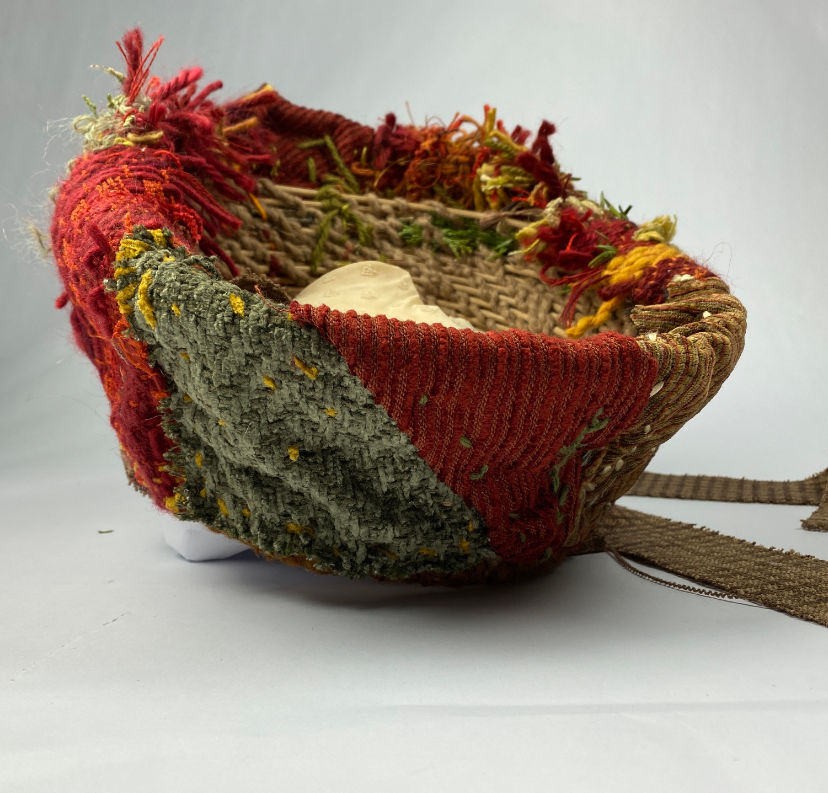
@nebluas • montera hat, weaving •
5 Questions:
1. My family moved due to the socio-economic corrupt governance of Peruvian governance. My abuelos and everyone before them are Quechua, who have lived in the mountains of Cotahuasi, Arequipa, Peru for generations of time and memorial. My abuelos moved from their homelands to Lima to give their kids, my parents the opportunity of education. My parents moved to the U.S because of the Fujimori regime that incited a mass genocide via sterilization of Quechua and Aymara people, as well as the bombings, disappearances, and violence between the Peruvian government and the Shining Path.
2. My family immigrated to the U.S. by supporting each other one at a time moving from Peru. I grew up with my abuelos and a tía living in the same home as my family and I. My dad’s side has 4 siblings as well as many primos, and my mom’s side has 6 siblings as well as many primos. Almost all the siblings from both sides of my family live in the U.S now with a split of more cousins in Peru than the U.S.
I grew up with many tíos and primos, birthdays, celebrations, good food, music and dancing. I had a family full of life here in the U.S and when my parents got their residency, with family in Peru. The project of colonization came with the implementation of the cis-hetero-patriarchy. As I grew older the misogyny in my family as well as my queerness created a rift that after 6 years of coming out and low to no contact, has just begun to be mended. My family moving away from our homelands and to the U.S also caused a loss of our Quechua heritage, language and community.
3. My family has survived the project of indigenous annihilation for generations. With this survival in the most recent generations of my parents came with an assimilation and transformation of culture of a mix between Catholicism and Quechua values and ways of life. I feel disconnected not having a relationship to land that my abuelos and everyone before them had. No soy de aquí, ni soy de alla, displaced from my homelands that my parents haven’t been back to my dad since he was 16 and my mother since she was a young child. For a long time, home to me was Norwalk, CT Lenapehoking territory, Peru when we would visit, and I’m an indigenous settler.
Quechua, disconnected from my language and land, living on other’s stolen native lands. Home now is Chicago, lands of Potawatomi, Odawa, and Ojibwe people.
4. As I am conscious and aware of being an indigenous and a settler on someone else’s land I’m trying to currently build a relationship with indigenous peoples of this lands by attending powwows hosted by the American Indian Center, and in joining a group of Native people creating an American Indian Movement chapter of Chicago. I’m learning Quechua on my own, to hopefully visit my homelands in years when I’m able to afford returning. I feel my roots dancing to huayno, huaylash, and salsa. I feel connected in my queerness and fluidity of gender and lesbianism. I feel connected to my creator Pachamama when I paint, weave, and create.
5. My hope is in immigrant and refugee youth. I believe in youth as the creators of the future, future ancestors. I moved to Chicago for a job as a Bilingual Youth Care Worker working with immigrant and refugee youth in a group home set up while they await their sponsorship cases.
I’m getting laid off March 31st, due to defunding of our main funded the Office of Refugee Resettlement. My hope is in the youth I work with, in the potentiality of their education and creation of their dreams. I dream through my art, through dance and singing to my people’s music. I’m building my dream of supporting youth by becoming an educator. I want to be able to return to my homelands as an educator to Quechua youth, teaching in my native language, return to my community with the resources and tools that caused my family to move foropportunity for in the first place.
___
Bio | Art Statement
santi[ago alvarado] (she+he+they) is a first-gen, peruvian-quechua, queer, transmasc, interdisciplinary artist and designer. santi is a bilingual youth care worker rooted in community, a part-time tattoo artist, enthusiastic plant guy, and lover of stories that involve god as change.
As a trans person of color, they are especially critical of colonial conceptions of a repressive gender and sexuality binary. Their work questions borders and boundaries of structurally oppressive systems such as racism, capitalism, colonialism, imperialism, and the cis-hetero-patriarchy.
They invite us to expand our possibilities— imagining and enacting a liberated future. They question the ideological terms that necessitate and justify conquest and colonization. santi creates from passion, enjoyment, and care. They explore these themes using interdisciplinary approaches of sculpture, painting, collage, performance, sound design, and weaving.
As a living ancestor, along with their ancestors of the past and future, santi shapes and is shaped by change. They continually practice celebrating life through actionable change, listening, and loving as deeply as they can.
______
Featured Artists | Akira – Light that Heals • Alejandra Lemus • Angie Zaveleta • Anna Silivonchik • Bane-xxa • Calayah • Catherine Economopoulos • Christian Joshua Varela Solis • Cindy Uriostegui • Darth Rudo • El Poeta • Grecia Solorio • Idil Duman • Javier Viñuela • Jimena Hernández Aguilar • Julia Obrien • Kaltra • Kybo • Lorena Salinas • Lydia Gunn • Mariana Perez • Mary Antar • Michael Azpeitia • Papaya Guayaba • Peauxline • Rita Garcia Šindelář • Roele Phantom • santi[ago alvarado] • Schantelle Alonzo “Mishipiku” • Scribe • Tai Kojro-Badziak • Toni Maugeri • Valeria Osornio • Victoria Park • Victoria-Riza • Yekseny Guerrero