
@itsvictoriariza •
5 Questions:
1. The driving reason for my family’s immigration from the Philippines to the United States was my lolo’s dream – to live in the land “flowing with milk and honey,” a Latter-day Saint reference to this country being a land of promise. My tatay* first came to the US in 1989. He joined the army in 1990 and was able to expedite my inay* and me to the US. Finally together again, we joined my Tatay in the United States in 1992.
*lolo, tagalog for grandfather
*tatay, father
*inay, mother
2. Lolo’s* desire to immigrate to America has mixed reactions amongst family members. For the older generation, Lolo’s story is glorified – an immigrant fulfilling the American Dream. For the younger generation, we see a father dictating his children’s lives to get what he wants. The older generation celebrates the opportunities America affords them. The younger generation feels the sting of the inequality and exploitation that produce those opportunities. It was never my tatay* and his siblings’ plan to come to America. Based on their stories, I inferred that they all changed their life plans to fulfill their father’s dream. My contempt for the “do as you’re told” dynamic between Filipino parents and their children has labeled me as disrespectful in my youth. Unbeknownst to me at the time, I was fighting for my autonomy, something that was so easily given up by the generation before me. To not have a role model of living one’s life for oneself has often left me feeling aimless or that my dreams were too lofty or selfish. I used to feel very angry at my family for this and believed that cutting ties with my family was the only solution. That anger is still there, but it’s not as big. Now, I hold
each of my family members’ story and their unspoken pain and give each of them
grace.
*lolo, grandfather
*tatay, father
3. I’ve struggled to feel at home anywhere. I wasn’t American in America and I wasn’t Filipino in the Philippines. I didn’t fit in with the societal expectations of my home state of Tennessee or the religious expectations of the church my parents converted to and raised me in, The Church of Jesus Christ of Latter-day Saints. The feeling that I was never enough was profound in each of these aspects. Leaving the LDS church, coming out as queer, and choosing to move to Chicago to fulfill my artistic goals – to live my life for myself – has helped me believe that I can be at home with myself, can recreate my Filipino-American and spiritual identities in ways that are my own, and create a home wherever I am.
4. I’m very close to my family – titas, titos, and pinsans – here in the United States. My relationship with my family in the Philippines is close enough considering the language barrier and the distance. I’ve lost several cousins here and in the Philippines and in those times of tragedy, I feel that rip in my family created by immigrating so deeply. I don’t know if I have found a way to make peace with this constant yearning to be with my whole family, but thank God for Facebook and for my basic tagalog. When I comment back to my tita, “salamat po, Tita!” my whole heart is in each and every word.
*tita, aunt
*tito, uncle
*pinsan, cousin
*salamat, thank you
*po, a respectful term used when speaking to elders
5. I feel hope in connecting and sharing community with people who navigate similar tensions within their heritage and identity. In moving to Chicago, for example, I have connected with other Filipino-Americans who have shared experiences. Like me, we want to stay connected to the traditions and the communities that raised us, but not beholden to that which restricts, and instead redefine the meaning of these identitiesin aspirational ways.
____
Bio
Victoria-Riza is an illustrator and artist. Her early works of fashion illustration were an exploration of diversity and culture and have since shifted focus from the runway to the dinner table. Her food drawings are a response to the growing recognition and popularity of Filipino food in U.S. culture, and through them she explores her Filipina-American identity and experiences.
Victoria-Riza is a one and a half generation Filipina, raised in Tennessee, she resides in Chicago with her husband and two kids.
___
Above: Two Filipino Cooks, One American Meal
Illustration on watercolor paper with watercolor paint, wax pastels, colored pencils, and ink.


My Kids Don’t Like Filipino Food #1 and #2 series of 2 drawings
Illustration on Pastel Paper with wax pastels and colored pencils.

Kare-Kare
Illustration on Pastel Paper with wax pastels and colored pencils.
Many Filipino-Americans relate to the challenge of maintaining the cuisine that connects us to our heritage and culture. This series, My Kids Don’t Like Filipino Food, laughs at moments when our attempts to pass on things we love don’t quite work out. Each illustration contrasts my children’s words with foods I see as beautiful, not scary, and delicious, not weird.
In Kare-Kare, the ingredients of a Filipino classic represent the duality of Filipino and American identities. Ingredients like eggplant, bok choy, and annatto seeds depict traditions preserved, whereas the replacement of sitow with green beans and oxtail with beef shank reflect adaptations that keep the vitality of our cuisine alive in a new environment. The Lingayan bagoon and the Skippy peanut butter in particular honor the space that can be made for both our Filipino and American identities.
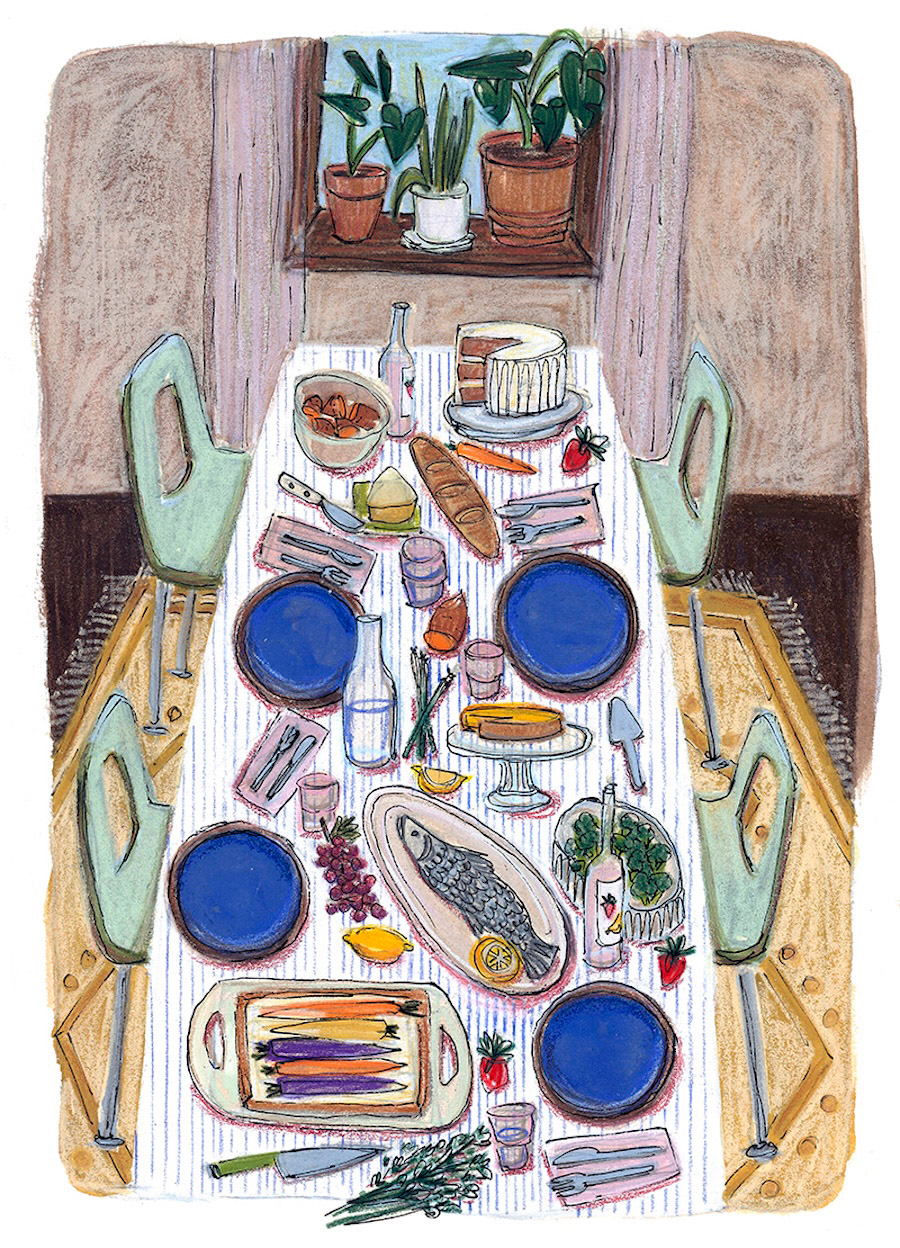
In Two Filipino Cooks, One American Meal is based on a real life dinner party. Preparing a distinctly Euro-American meal does not diminish the cooks’ Filipino identity; instead, it underscores the permeability of cultural boundaries and suggests that cultural identity is not defined by rigid categories, but by the lived experiences of individuals.
______
Featured Artists | Akira – Light that Heals • Alejandra Lemus • Angie Zaveleta • Anna Silivonchik • Bane-xxa • Calayah • Catherine Economopoulos • Christian Joshua Varela Solis • Cindy Uriostegui • Darth Rudo • El Poeta • Grecia Solorio • Idil Duman • Javier Viñuela • Jimena Hernández Aguilar • Julia Obrien • Kaltra • Kybo • Lorena Salinas • Lydia Gunn • Mariana Perez • Mary Antar • Michael Azpeitia • Papaya Guayaba • Peauxline • Rita Garcia Šindelář • Roele Phantom • santi[ago alvarado] • Schantelle Alonzo “Mishipiku” • Scribe • Tai Kojro-Badziak • Toni Maugeri • Valeria Osornio • Victoria Park • Victoria-Riza • Yekseny Guerrero