
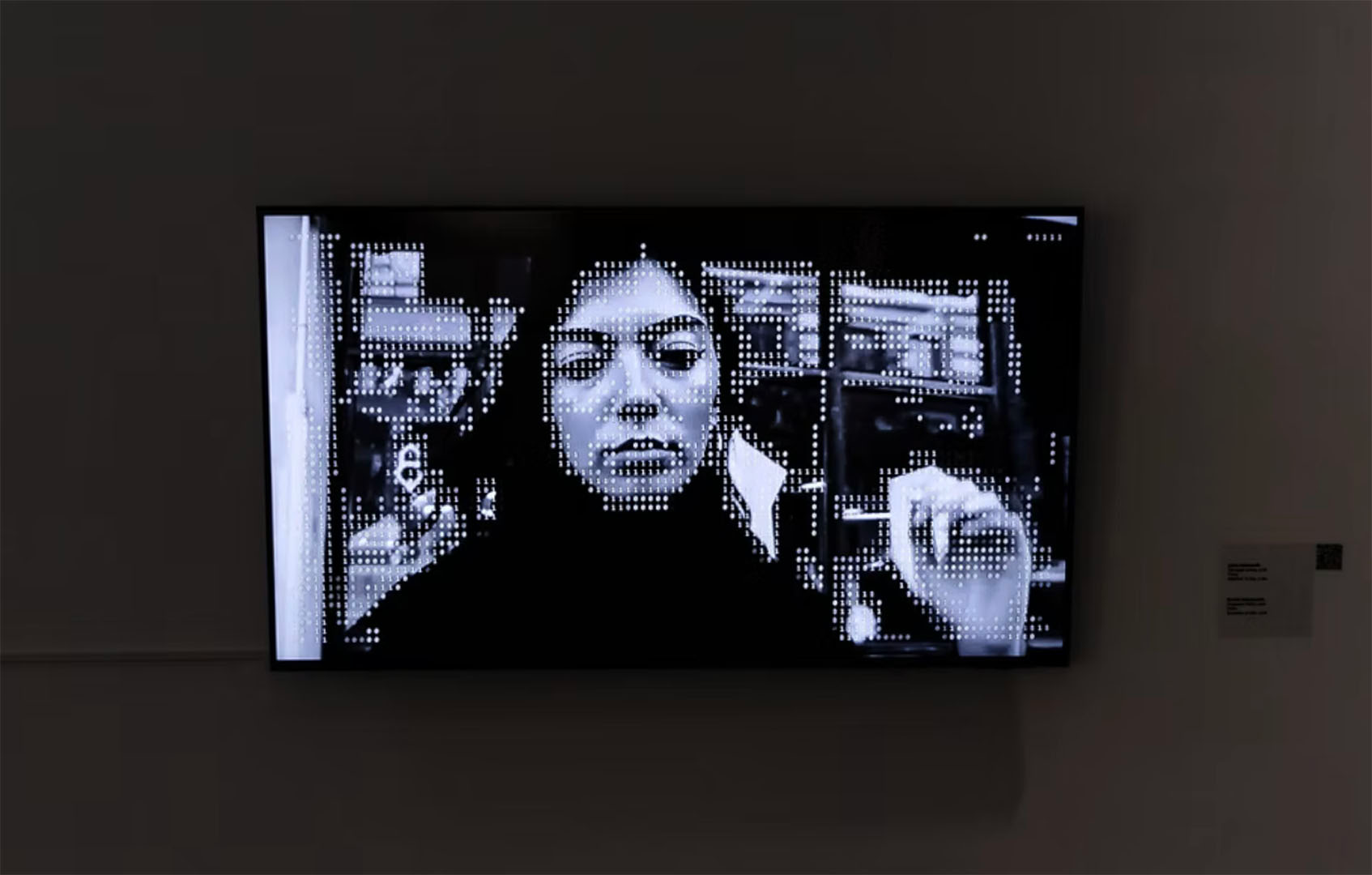
@salamzadeh.art | salamzadeh.art | Temporary Folder | video, 3:55
Shalala Salamzadeh (b. 1995, Baku, Azerbaijan) is a multidisciplinary artist and designer whose work spans video art, generative processes, and post-internet aesthetics. Her practice explores the psychological states of the individual in the digital era, confronting the ways in which collective memory, identity, and cultural archetypes are shaped and distorted by algorithms, cyber aesthetics, and technological mediation.
Her evolving practice has been featured in exhibitions, festivals, and biennales, including The Wrong Biennale, the Tashkent International Biennale of Contemporary Art, Fotografisk Center in Copenhagen, Pejman Foundation in Tehran, Gazelli Art House, and Sapar Contemporary in New York. Her video installations and experimental works have also been shown at exhibitions across Germany, Korea, and Scotland.
She currently lives and works in Stockholm, Sweden.
5 Questions
1. My journey is not centered around the United States, but around displacement itself.
I moved from Baku to Stockholm during a transitional moment in my life, following my husband’s studies. It was not a migration driven purely by necessity or opportunity, but by a more ambiguous impulse, a need for distance from the systems that had shaped my sense of self.
This movement unfolded within global structures of education and mobility, where individual decisions are entangled with larger geopolitical and institutional frameworks.
The experience was neither linear nor resolved. It produced a persistent state of in-betweenness, between languages, cultural codes, and versions of identity.
Over time, I began to understand relocation not as a change of place, but as a shift in perception. It alters how memory is constructed, how reality is processed, and how one relates emotionally to both past and present.
2. Distance exposed the architecture of my relationships.
My family is emotionally intense, deeply intertwined, and shaped by dependency as much as care. Being physically removed from them made visible patterns that were previously invisible – expectations, guilt, roles I had unconsciously inhabited.
At the same time, distance did not dissolve connection. It transformed it into something more abstract: less daily presence, more psychological presence.
Community, for me, no longer exists as a stable group of people. It feels fragmented, partially rooted in my past, partially dispersed across digital space, and partially imagined. It is less about belonging, and more about navigating multiple overlapping realities of connection.
3. Home used to be a fixed place, tied to geography and familiarity.
After relocation, it became unstable.
I began to see home as something constructed… through memory, habits, interfaces, and systems. Tradition, similarly, stopped feeling like something inherited and ϐixed. It started to behave more like data: something that can be reinterpreted, fragmented, and reassembled.
My work reϐlects this shift. I am interested in how cultural memory survives when remove d from its original environment, and how it mutates under technological and psychological pressure.
4. The tension is strongest in moments of stillness.
In unfamiliar environments, especially those that are structured, quiet, and highly ordered, like Scandinavian cities, I become acutely aware of my internal contrast. My roots are emotionally dense, chaotic, and expressive. My present environment is restrained and controlled.
I do not try to resolve this contradiction.
Instead, I treat it as material. The friction between these two states becomes a productive space, where perception sharpens, and where my artistic language emerges.
5. My hope is not centered around stability.
It is centered around clarity and authorship.
I want to build a body of work that translates internal states shaped by displacement, digital environments, and cultural memory into precise visual systems. I am not searching for a singular identity or ϐixed belonging. I am building a practice that can exist within uncertainty and still produce meaning.
The dream is not to arrive somewhere, but to construct a language strong enough to hold complexity without simplifying it.
Butterfly Effect: Bridging Borders Exhibiting Artists
Aileen Nicole Castro • Akira – Light that Heals • Alejandra Lemus • Alex Covarrubias – Red Cave • Anna Silvonchik • Arte Duran • Bane.xxa • Christian Joshua Varela Solis • Cindy Uriostegui – Cattco • Cristina Marquez • Elena Diadenko • Elena Pach • EMNI • Gabriel Guzman • Grecia Solorio • Idil Duman • Isaac Galvan • Janis Appleton* • Javier Viñuela*• Kaltra • Kybo • Mariana Perez • Mary Antar • Pamela Rubi Trejo Soria • Peauxline • raqui • Riesling Dong • Rocio “Chio” Cabrera-Coz • Sailee Charlu • Shalala Salamzadeh • Sharvani Rathna Chittem* • Stef Skills • Victoria Park • *Group collaboration