
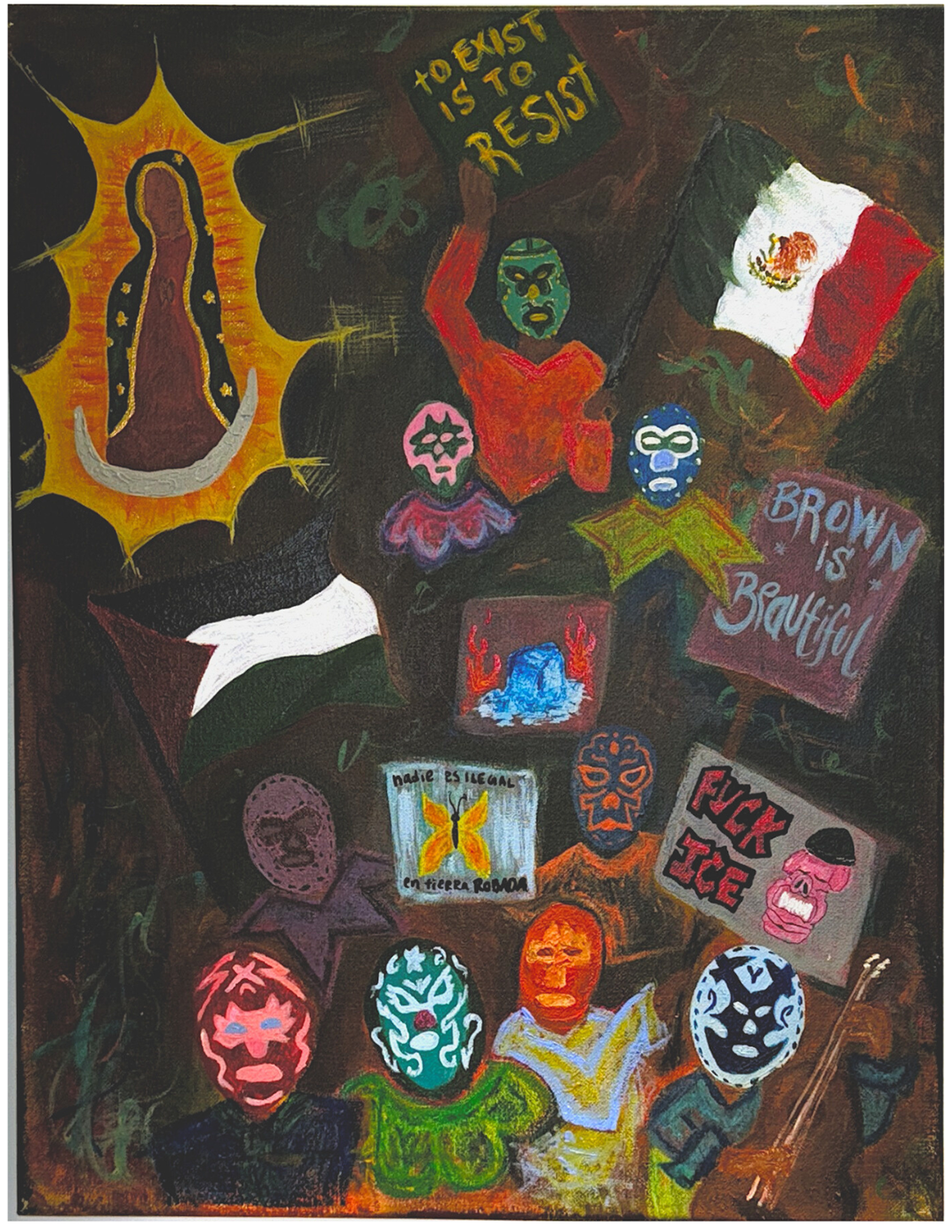
@emni_arte | Luchando por la Libertad | 16×20 Acrylic and Oil Pastels on Canvas
EMNI is a multidisciplinary artist working across painting, photography, poetry, and mixed media to explore survival, tenderness, and memory. Rooted in personal experience and shaped by her observations of others, her work reflects layered inner and outer dialogues. Stories of love, pain, migration, and home. Drawing inspiration from everyday textures and memories of Mexico, EMNI seeks to humanize immigrant narratives and create space for reflection, connection, and reclamation. Through both visual and written language, she creates work that is intimate yet collective. A meditation on navigating multiple worlds while remaining grounded in presence and possibility.
Art has been a tool for healing, allowing her to process childhood experiences and her immigrant journey in a way that feels both safe and transformative. Where words have fallen short, a brushstroke has helped her understand and accept what she has lived through; at other times, poetry becomes an extension of the image, giving language to what cannot be seen. Her practice moves fluidly between mediums, each one supporting and expanding the other. At its core is a hope: that her work might offer others the same sense of healing it has given her.
Guided by curiosity, EMNI has always been drawn to working across disciplines, exploring how different forms can intersect and strengthen one another. She is deeply interested in traditional Mexican artesanía, seeking to reconnect with cultural practices that are often overlooked or excluded from the fine art spaces. Though she does not come from a family of artists, her work is a way of reclaiming that lineage and bridging heritage, lived experience, and experimentation.
Her work often examines what it means to live as a Mexican immigrant in the United States. Caught between cultures, languages, and expectations. Having adapted to American norms while feeling the distance from her mother tongue and traditions, she explores the complexity of existing “in-between.” Through her art, she navigates questions of identity, belonging, labor, love, and legacy in a world that can be hostile toward immigrant communities. Though she identifies as a quiet person, her work speaks loudly. It became a space where she is able to be bold, vulnerable, and outspoken. Through this practice, she challenges the criminalization of Black and Latino communities and insists on their humanity, dignity, and presence.
5 Questions
1. My parents had me at a very young age and were struggling to stay financially afloat. When my mom was pregnant with my sister, my dad made the difficult decision to come to the U.S. for what was supposed to be six months, hoping to earn enough money to build a home and return. Those six months turned into a year after he was involved in a serious motorcycle accident that left him unable to work and burdened with hospital debt. Back in Mexico, my mom could no longer care for both of us on her own. She told my dad that either he needed to return, or we would have to join him. Leaving behind their families and support systems was not an easy choice, but they weighed their options and ultimately decided that moving to the U.S. would offer more stability and better educational opportunities for us. Opportunities that were difficult to access in Mexico without financial resources. That decision led to our journey here, even though it meant being separated from everything familiar.
2. Our experience has made us incredibly close. We rely on one another for support, hope, and guidance. My parents’ sacrifices shaped the way we approach life. They taught us to work hard and to pursue our dreams, even when the path feels uncertain.
From a young age, I was aware of our undocumented status. My mom prepared me for the challenges that would come with applying to school, accessing financial aid, getting a driver’s license, finding housing, even going to the doctor. Everyday tasks often required extra steps, extra proof, and extra resilience. While my parents guided me as much as they could, I also had to learn to navigate many systems on my own, asking questions and teaching myself along the way. As the first in my family to graduate high school, that journey came with both pressure and pride.
Our community extends beyond blood relatives. Many of the people we grew up with became a chosen family, and our friends are now like cousins. Together, we’ve built a sense of belonging rooted in shared experience, care, and mutual support.
3. I visit my parents as often as I can, sometimes every weekend, sometimes just during holidays. My sisters still live with them, and when I’m away for long periods, I feel that distance. Each time I return, I notice subtle changes. Traditions fading, language shifting, pieces of our culture becoming less present over time. At the same time, I’ve begun to reconnect with those traditions through my own curiosity and artistic practice. By asking my mom questions and involving her in my work, we’ve revived certain traditions, like celebrating Día de los Muertos and creating an altar together. Last year, my grandmother was finally able to visit after more than a decade apart. Experiencing a relationship with her for the first time at 23 years old was both beautiful and unfamiliar. Moments like that remind me that “family” is not only defined by blood. Many of our closest relationships are with family friends we’ve grown up with. They are people who have become an essential part of our sense of home.
4. I feel that pull most strongly when I reflect on who I am and who I want to become. When I’m painting, journaling, or sitting with my thoughts. It comes up when I miss my family, when I see artwork that reminds me of home, or when I talk to my cousins in Mexico and hear about their lives. It’s also present in everyday moments, watching the news, attending concerts by Mexican artists, or when friends plan trips to Mexico that I’m unable to take.
I process those feelings through my art. I translate them into paintings, writing, and music, finding ways to release the pain while holding onto the memories and the longing. That longing becomes a form of hope, something that keeps me connected to where I come from and reminds me that one day, I may be able to return.
5. My hope is centered around my family and my commitment to becoming the artist I’ve always dreamed of being. For a time, I set that dream aside in pursuit of a more “stable” path, but I eventually realized I needed to give myself the chance to fully pursue my passion. I want to move beyond the mindset of simply surviving and to challenge the idea that my life must be limited to working without rest or imagination. While I’m grateful for the opportunities I’ve had, I’m also aware of the hardships and barriers my family has faced. My goal is to build a life and career that honors those sacrifices while also creating space for freedom, creativity, and possibility.
Butterfly Effect: Bridging Borders Exhibiting Artists
Aileen Nicole Castro • Akira – Light that Heals • Alejandra Lemus • Alex Covarrubias – Red Cave • Anna Silvonchik • Arte Duran • Bane.xxa • Christian Joshua Varela Solis • Cindy Uriostegui – Cattco • Cristina Marquez • Elena Diadenko • Elena Pach • EMNI • Gabriel Guzman • Grecia Solorio • Idil Duman • Isaac Galvan • Janis Appleton* • Javier Viñuela*• Kaltra • Kybo • Mariana Perez • Mary Antar • Pamela Rubi Trejo Soria • Peauxline • raqui • Riesling Dong • Rocio “Chio” Cabrera-Coz • Sailee Charlu • Shalala Salamzadeh • Sharvani Rathna Chittem* • Stef Skills • Victoria Park • *Group collaboration