
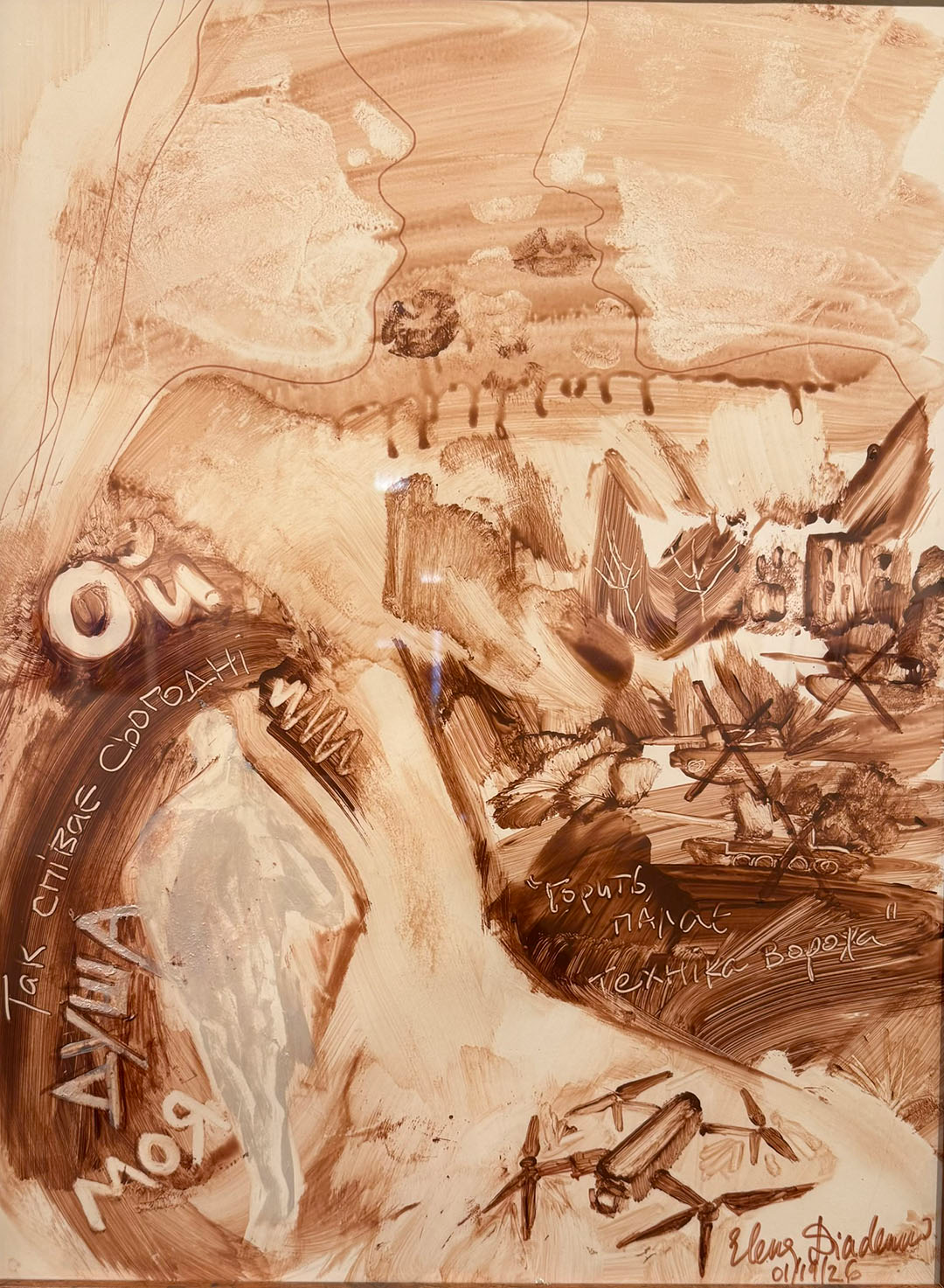
@diadenko_elena | elenadiadenko.com | Oh, this is the way my soul sings today / Ой, так сьогодні співає душа моя | 2026, tempera on paper, 18 × 24 in


Oh, I’m not drunk; I’m simply in love / Ой, я не п’яна; я просто закохана | 2026, tempera on paper, 18 × 24 in
Oh, I will follow you barefoot to the end of the earth / Ой, за тобою босоніж нa край землі | 2026, tempera on paper, 18 × 24 in
As an artist and educator, my creative journey is deeply rooted in exploration, expression, and connection. I view art as a powerful language that transcends boundaries and communicates beyond words.
My artistic practice spans a variety of mediums, including acrylics, mixed media, and glass painting. Through these diverse mediums, I engage with universal themes of identity, culture, spirituality, and healing, inviting the viewer to connect with both the visible and the invisible forces that shape the human experience.
Born in Ukraine and now living and working in Chicago, my art is heavily influenced by my heritage, particularly by the rich traditions of Ukrainian culture. However, my artistic expression is not confined to any one tradition. I work in both abstract and figurative styles, creating layered, dynamic compositions that explore the complexity of the human spirit. Whether using acrylics, mixed media, or glass, my work seeks to bridge the gap between the personal and the universal, offering a glimpse into the profound emotional and spiritual landscapes that define our lives.
Spirituality and healing are central themes in my artwork. I am fascinated by the invisible forces that bind individuals to their cultural histories, to one another, and to the broader universe. In my abstract-figurative work, I strive to express moments of spiritual awakening, transformation, and inner strength. Mixed media and acrylics allow me to layer textures, colors, and forms in a way that reflects the complexity of human emotion and the healing process. The combination of vibrant hues and intricate textures in my work mirrors the fragility and resilience of life itself.
While I do incorporate traditional Ukrainian glass painting into my work, I do not limit myself to one medium or style. The flexibility of mixed media and acrylics allows me to experiment freely and intuitively, capturing fleeting moments of clarity, struggle, or growth. My mixed media works, in particular, offer a tactile experience that invites the viewer to explore deeper layers of meaning, echoing the emotional depth of the human condition.
Through my art, I strive to bridge the gap between the personal and the universal, offering a glimpse into the profound emotional and spiritual landscapes that define our lives.
5 Questions
1.My journey to the United States began in 1992, during a turbulent and uncertain period in the former Soviet Union. Ukraine was going through a revolutionary transition — the old system had collapsed, the new one was unstable, and daily life was marked by political chaos, economic collapse, and a sense that the future was impossible to predict.
I made the decision to come to the U.S. entirely on my own. I arrived without knowing English, without family waiting for me, and without financial resources. What I did have was determination and the belief that I could build a safer, more stable life than what was possible in the post-Soviet environment.
Leaving everything familiar behind was difficult, but the driving reason for this journey was simple: survival and opportunity. The United States represented a place where hard work could lead to progress, where freedom and stability were possible, and where I could rebuild my life from the ground up.
Starting over alone was challenging, but it also shaped who I am today — resilient, adaptable, and grateful for the chance to create a future that once felt out of reach.
2. Leaving Ukraine alone in 1992—without English, family, or financial security—shaped not only who I became, but also how I relate to others. That experience of starting from nothing taught me resilience, empathy, and a profound sense of responsibility to help those who face hardship. It also made me deeply value community, because community was what I lacked most when I first arrived in the United States.
Over time, that longing transformed into action. In recent years, I have devoted myself to supporting both my family abroad and the broader Ukrainian community in Chicago. When the war in Ukraine began in 2022, my personal history made it impossible for me to stand by. I understood what it meant to feel uprooted, uncertain, and afraid. That understanding became my driving force.
Between 2022 and 2024, I helped raise $100,000 for Ukrainian humanitarian efforts—supporting soldiers with medical aid and helping animals affected by the war. I organized art exhibitions, taught community art classes, and used creativity as a way to heal, connect, and empower. Art became my language long before I mastered English, and now it is the bridge I use to bring people together.
In 2024, I stepped into a leadership role as President of the Ukrainian National Women’s League of America, Branch #36. This community feels like an extended family—intergenerational, resilient, and united by culture, memory, and hope. Through this work, I’ve expanded my artistic offerings to include traditional Ukrainian folk arts such as Petrykivka painting, Batik, and pumpkin painting, giving people—especially young Ukrainian Americans—a way to stay connected to their heritage.
One of the projects closest to my heart is the Radius Project at the Ukrainian Institute of Modern Art, which brought together community members of all ages to create art inspired by personal memories, letters, and photographs from Ukraine. The final exhibition, unveiled in January 2024, felt like a collective heartbeat—an expression of shared identity, loss, and pride.
My community work extends beyond Ukrainian spaces. I’ve collaborated on public art installations like the My Painted Lyre exhibit in Greektown and the Cicada Project, blending cultural storytelling with nature and public engagement. I’ve also partnered with the Shedd Aquarium on art initiatives that connect creativity with environmental awareness.
For 26 years, I taught visual arts and special education in Chicago high schools serving predominantly Latino and African-American students. More than 40,000 students passed through my classroom. Many of them came from immigrant families or faced challenges similar to my own, and I saw my younger self in them. Teaching wasn’t just a job—it was a way to give others the support I once needed.
Today, my family and community are intertwined. My family in Ukraine inspires my work; my community in Chicago sustains it. Together, they form a network of love, resilience, and shared purpose. My immigration story taught me that home is not only a place—it is the people you choose to stand with, uplift, and fight for. And in that sense, I have built a home far larger and more beautiful than I ever imagined when I first arrived in America alone.
3. My relationship to “home” has become beautifully complex. I now carry two homes within me—Ukraine, where my roots, memories, and cultural identity were formed, and the United States, where I rebuilt my life from nothing and created a future for myself.
When I first arrived in the U.S. in 1992, I had no English, no family, and no financial security. I had to adapt quickly, and over time I fully assimilated into American society—building a career, a community, and a sense of belonging. America became a place where I could grow, contribute, and feel safe.
But my connection to Ukraine never faded. If anything, it has grown stronger. Especially during the war, returning to Ukraine has become an emotional necessity. I visit regularly—not just to see loved ones, but to stay connected to the land and culture that shaped me. Each visit reminds me of who I am and why I work so hard to support my community here in Chicago.
Today, my identity is a blend of both worlds. Home is not a single place anymore—it is a bridge. It is the Ukrainian traditions I teach through art, the American values I live every day, and the community I’ve built that spans continents.
My relationship to tradition has also evolved. When I first immigrated, I tried to adapt as quickly as possible. Now, I see tradition as something to protect, share, and pass on. Through my art, cultural workshops, and community leadership, I keep Ukrainian heritage alive—not only for myself, but for the next generation.
In many ways, my two homes have shaped me into someone who can live between cultures, connect people, and build community wherever I go. That dual identity is no longer a challenge—it is my greatest strength.
4. I feel the pull between my present life and my roots most intensely during moments of crisis and celebration—times when the heart instinctively reaches for home.
Since the war began in Ukraine, that pull has become almost physical. When I see images of my homeland under attack, or hear the voices of friends and family living through fear and uncertainty, a part of me aches to be there with them. At the same time, my life in the United States—my work, my community, my responsibilities—anchors me here. It creates a constant tension between where I am needed and where my heart longs to be.
I reconcile these competing feelings by turning them into action. Instead of choosing one home over the other, I let both shape who I am and what I do. My American life gives me the stability, resources, and platform to support Ukraine in ways I never could if I had stayed. My Ukrainian roots give me purpose, identity, and the emotional fire that fuels my work.
When I organize fundraisers, teach Ukrainian folk art, or lead community projects, I feel the two halves of my life come together. I am physically in Chicago but spiritually connected to Ukraine. I am building a future here while honoring the past that made me.
The pull between my two homes will probably never disappear—and I’ve learned not to expect it to. Instead, I’ve come to see it as a reminder of how deeply I belong to both places. My identity is not split; it is expanded. I am Ukrainian. I am American. And the space between those two worlds is where my purpose lives.
5. My hope is rooted in something both deeply personal and profoundly universal: peace in Ukraine. Every day, I carry the weight of watching my homeland suffer, and the fear of what each new day might bring. That fear becomes even more real because the person I love—my fiancé—is serving on the front lines with the Ukrainian Armed Forces. My greatest hope is simple and enormous at the same time: that he comes home alive, safe, and whole.
This hope shapes everything I do. It fuels my work in the community, my art, my advocacy, and my commitment to supporting Ukraine from afar. It keeps me moving forward on days when the news feels unbearable. It reminds me that love can be both fragile and incredibly strong.
As for my dreams, they are intertwined with this hope. I dream of a future where my fiancé and I can build a peaceful life together, without the shadow of war. I dream of a Ukraine that is free, secure, and rebuilding with pride. I dream of continuing to use my art and my voice to help heal, connect, and preserve our culture for the next generation.
Butterfly Effect: Bridging Borders Exhibiting Artists
Aileen Nicole Castro • Akira – Light that Heals • Alejandra Lemus • Alex Covarrubias – Red Cave • Anna Silvonchik • Arte Duran • Bane.xxa • Christian Joshua Varela Solis • Cindy Uriostegui – Cattco • Cristina Marquez • Elena Diadenko • Elena Pach • EMNI • Gabriel Guzman • Grecia Solorio • Idil Duman • Isaac Galvan • Janis Appleton* • Javier Viñuela*• Kaltra • Kybo • Mariana Perez • Mary Antar • Pamela Rubi Trejo Soria • Peauxline • raqui • Riesling Dong • Rocio “Chio” Cabrera-Coz • Sailee Charlu • Shalala Salamzadeh • Sharvani Rathna Chittem* • Stef Skills • Victoria Park • *Group collaboration