
@brekkie.rice


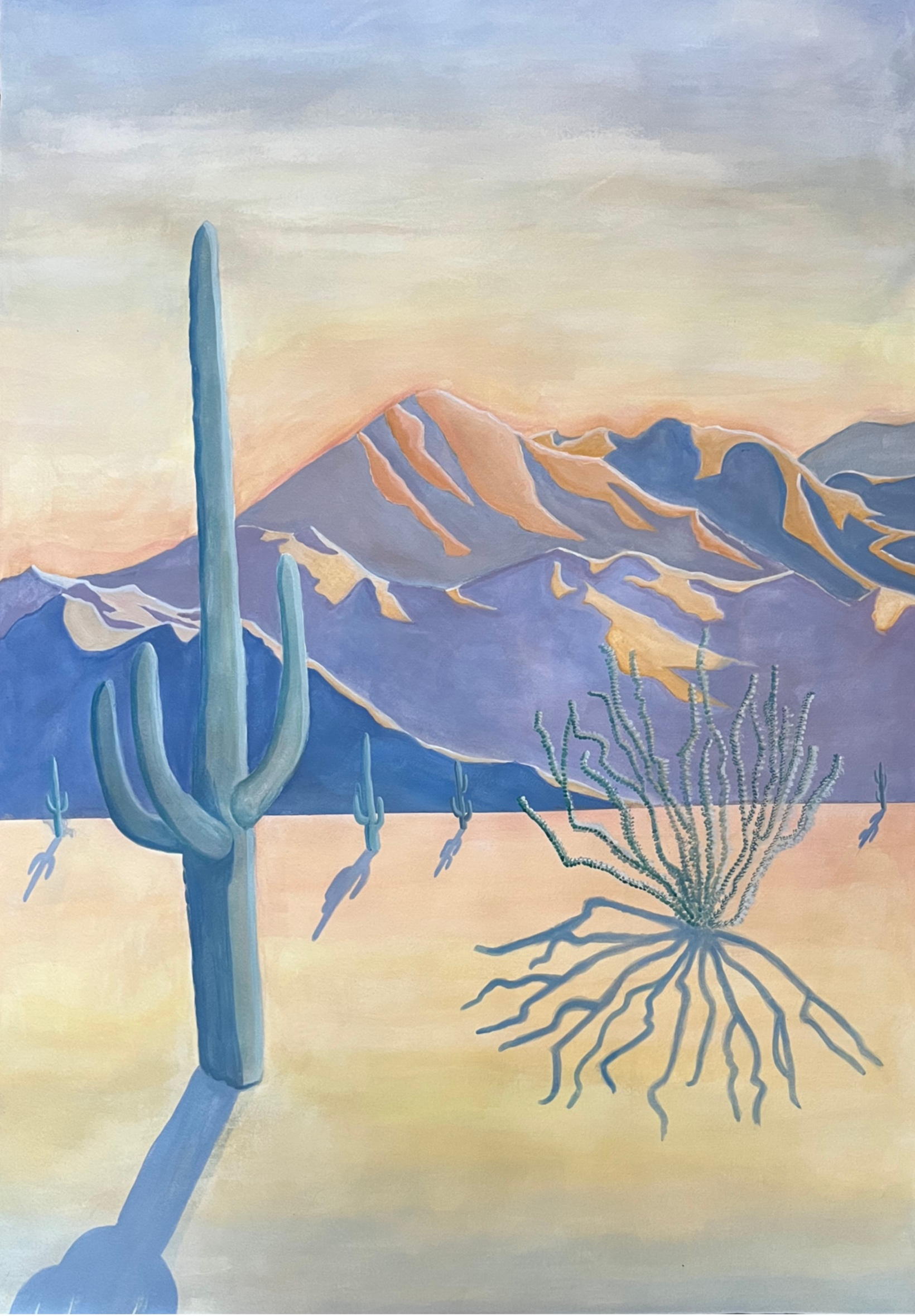
I made these two paintings almost a year a part and looking back this coincides with annual visits to family for the holidays. Dusk in the Desert is a familiar scene of an expansive desert dotted with ancient, looming saguaro. The backdrop of my childhood and a view I miss dearly. I often made time to watch the sunset in Arizona and when I picture home this is what I see. Dawn in the Taro Patch is a morning well-spent at a farm in Hawaii. Farming and agriculture is cemented in my lineage and how much of my family has spent their time. I made these two pieces as two halves to a whole, a diptych that maps some parts of our story.
_____
Describe the journey it took for you and/or family to be presently in the US. What was the driving reason for this journey?
We are here as a product of many migrations and motivations: to feed their families, to follow a lover, to dodge a draft, to leave behind a country with shifting borders. We made new homes in this country following the promise of labor opportunity and found it in Chicago storefronts and Hawaii pineapple plantations. My parents followed the same call to Arizona and eventually found our way back to Chicago.
How has your immigration story impacted your relationship with your family and community? What does your family/community look and feel like?
There is distance between myself and my family, but we are finding our bridges. They bite so ravenously into the stories and gods of our colonizers. But when you migrate, when you leave behind your community and culture and land, it leaves you starving, you pagkakamay what’s in front of you. Our ancestors had little choice but to conform and our bodies do not forget that. At dinner tables, pride for our stories can be coaxed out of aunties and omas. I can look past the white face of their chosen god and share reverence for the lands we’ve stood on. We spend hours in the kitchen baking a mokkatorte. We twirl in heirloom barongs and ternos in the living room. I tinikling in the club with found family.
What is your relationship to home and/or tradition and how has that changed?
I internalized being made up of so many places to mean I belonged to none. Now that I can sit with the heartbreak of missing many places at once, I can find belonging in the lands we’ve settled in, moved through, or left behind. I find it in the city I live in when I put my head into the lake and the water twinkles in recognition. When visiting old friends in the sunny and saguaro-littered desert I grew up in. When stomping barefoot in a taro patch, pulling weeds for the goats.
When do you feel the pull between your present life and your roots the strongest, and how do you reconcile those competing feelings?
Like an American, I had settled for an english-speaking mouth and a whitened phenotype. But there is an American individuality at odds with transpersonal filipiniality. They stole our languages so it took time to name the dissonance. I can see our roots, thick and sprawling, beneath the concrete poured over what we used to know. Glimpses of our nature peek through cracks, and my eyes widen in remembering. I find new and familiar words on my tongue: kalikasan, kapwa, kaluluwa. I feel the pulls and tugs as an expansion.
What is your hope centered around? What dreams are you building for yourself?
Connection to queer, radical pinoys! The wave of relief at the joining of brown hands. We find each other at community farms, on dance floors and karaoke bars, eyes locking in mutual aid groups, lit up at drag shows. We can speak without having to preface with centuries of suffering and shoulder the weight of resistance together. I am so thankful to share the love of biko and sinigang and the clacking of bamboo poles. I wonder if my family hangs their heads in shame at me and my bakla friends and I dream that they do not. I dream that I can lift mine out of its bow.