
@artbypepperplease.
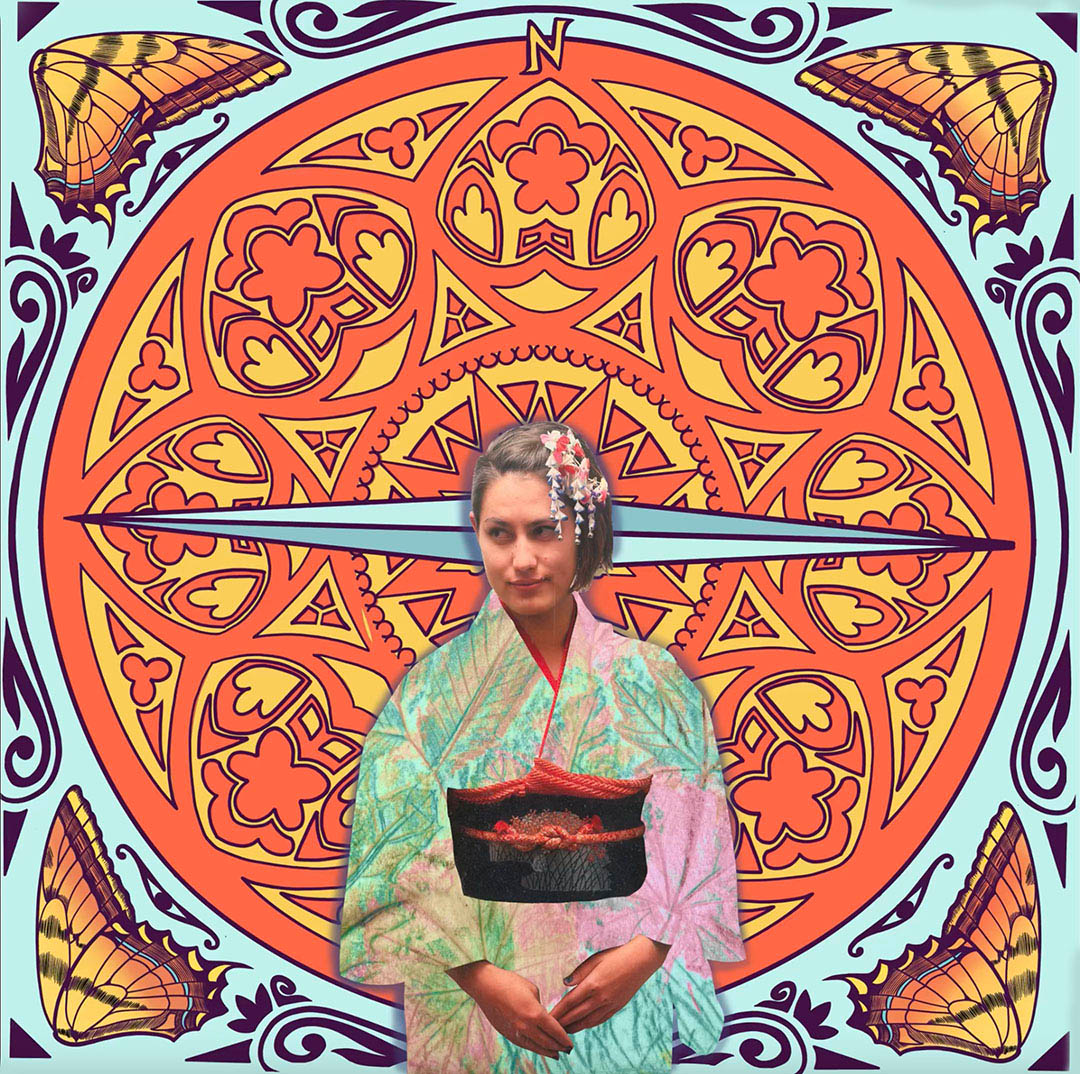
These pieces came to me as I reflected on my family’s journey to get here and my relationship to home and tradition. I included movement in my pieces as a nod to migration and collage as a reference to mixed identity. I played with the duality of the familiar and the foreign to represent my feelings about displacement. My genes come from two different lines of immigration, yet I’m planted in American soil. The wild tales of my parents made for excellent stories that bonded my immediate family, but left me yearning for more. Together, these pieces showcase an artist who refuses to be one thing and resists categorization.
Compass Self Portrait | The disc in “Compass” is modeled after a stained-glass window in Prague Castle, while my kimono features my own artwork.

Mixed | The triptic quality of “Mixed” honors the love that persevered despite cultural differences and led to my little hearth.
Hearth | The animated fire in “Hearth” should be inviting. Imagine gathering around it to eat food and tell stories as the stars make their way across the sky.
I am not an animator… I think of almost all my artistic work as a collage of some sort, reflecting the complex nature of my identity. While I was born here, my mother and my dad’s mother were immigrants. Based on the stories I’ve heard from dictatorial regimes and uprooting to the US, I thought I might have something interesting to say on this topic. My perspective is that of a mixed-ethnicity naturalized U.S. citizen who constantly feels lost between cultural spaces.
____
The primary reason for settling in the U.S. was love.
My grandfather was stationed in Okinawa during the Cold War. This is how he met Yuriko Itokazu, my grandmother. My grandfather didn’t have much say in where the military sent him. Sometimes my grandmother could migrate with him, and sometimes they’d be apart. They raised 2 kids before settling in California. My half Asian dad was accustomed to moving from place to place, unlike my mother.
The ability to travel allowed people from across the world to meet each other and form bonds. The Communist Occupation across Eastern Europe restricted travel in and out of the Soviet Union. They restricted anything that came from the west- clothes, food, music, and, importantly, the news and media. The people weren’t allowed to see how life was outside the Eastern Bloc. It was important that the USSR be a closed system. Communism valued sameness- equality at the cost of equity. It was a dangerous time to have a creative voice. The government ensured compliance through fear. The Secret Police wouldn’t just target rebels; they would kill their families as well. Violence was normalized. The ability to safely cross borders after the USSR fell and meet people from different walks of life is what led to my happy family.
When my mom finally visited the United States and met my dad. Their love bloomed quickly, but my mom’s legal status did not.
It took my mom 6 years to legally acquire her Green card, and even longer to become a U.S. citizen. The process was far from smooth. Going through “the right” channels had long wait times, laws would change halfway through a procedure, and immigration attorneys would lose and misprint documents. When my mom got her fingerprints done, she had to redo them because authorized state centers changed during the long process, leading the new computer system to automatically reject her application. Technological glitches and human organizational errors aside, citizenship requires a US history exam that must be conducted in English.
The migration of people is as natural as the movement of the stars across the sky, yet the concept of borders has made the journey unnecessarily difficult. People travel for a variety of reasons, but the decision to settle in a new place is usually driven by love. The ability to migrate allows you to choose the best place for your family and keep your loved ones close.
My hearth is small. The branches that built my fire came from faraway places with roots that split and stretch into multiple directions- no single point of origin. My family would sit around the fire, laughing with food in our mouths as my parents recounted stories of how the hearth came to be. The prologue to my birth was as familiar as the sun and yet as foreign as the moon. These stories became legends, well-known but mystical to my 21st-century experience. While I have never interacted with a pager or a typewriter, these magical devices were essential to understanding my history. Regimes that no longer exist today influenced my parents’ decisions and, in turn, shaped my perspective of the world decades later.
I grew up hearing stories of how my parents met in 1994. I heard tales of exotic lands with people who look like me but do not speak my language. People often asked if I was adopted when I was with my mom. Then I suddenly “make sense” once they see my dad’s complexion. To my dad’s side, I’m too American. To my mother’s side, I’m not Czech enough. And to Americans, I’m an ambiguous puzzle that doesn’t fit the picture.
I have relatives around the world whom I’ve never met due to the difficulty of travel. My grandma would visit from Europe once a year, and we would visit my grandpa in California every couple of years. Holidays were just me, my sister, my parents, and my dad would call his parents. Today, my family has grown to include a brother-in-law, his extended family, and my partner. My family is vast, but my hearth is small. Entry to our community is earned through acceptance and openness.
Our traditions have evolved in the new world to survive the different landscapes. The traditions that follow us are the ones that bring comfort and nostalgia. As we form lasting relationships, we share the rituals that feel like home. My mom’s food and superstitions were integral to my childhood, although they weren’t made with the exact ingredients found in Europe. Home is tattooed on my shoulder. A view of the mountains and the thought of my sister are inked in my skin as a reminder of home, wherever I go. In my lineage, home is not a place; it’s where your family is. But being the only one who grew up in a single location, I can’t help but think of home as the artifact of childhood memories.
I left the familiarity of my childhood behind when I moved to Chicago. Navigating the city is a completely different lifestyle from my mountainous origins. There is no trail for me to follow except to find community. I feel a yearning tug between my roots and my present life when I see how lively the cultural community here is. I love to see families gather for traditional dance, celebrations, and meals at the park, but it’s too late for me to be invited. Growing up, there was no one else around who practiced our ancestral traditions, so there was no need for a special supermarket or community event. We found community in the American way. The need to assimilate cut our roots from reaching too far into the past. My family had left their world behind for something better afterall, why would we bring it back up? With a hearth so small, I can only interact with what’s right in front of me. Reaching back further is like falling into a fairytale. I hope travel more in the future and see where my family came from. Perhaps seeing these exotic lands will explain how I am. For now, I have to be proud that my differences make me unique, something new, interesting, and beautiful.
My hope comes from the evidence that people from different backgrounds can get along. My existence as a mixed/ multicultural individual serves as proof that people are capable of kindness and understanding towards one another. I hope others recognize that we have more in common than we realize, and that we need to stop fighting for dominance. Right now, our government wants homogeneity, not equality. I want to build community with people from diverse backgrounds.