
@ramintakloo
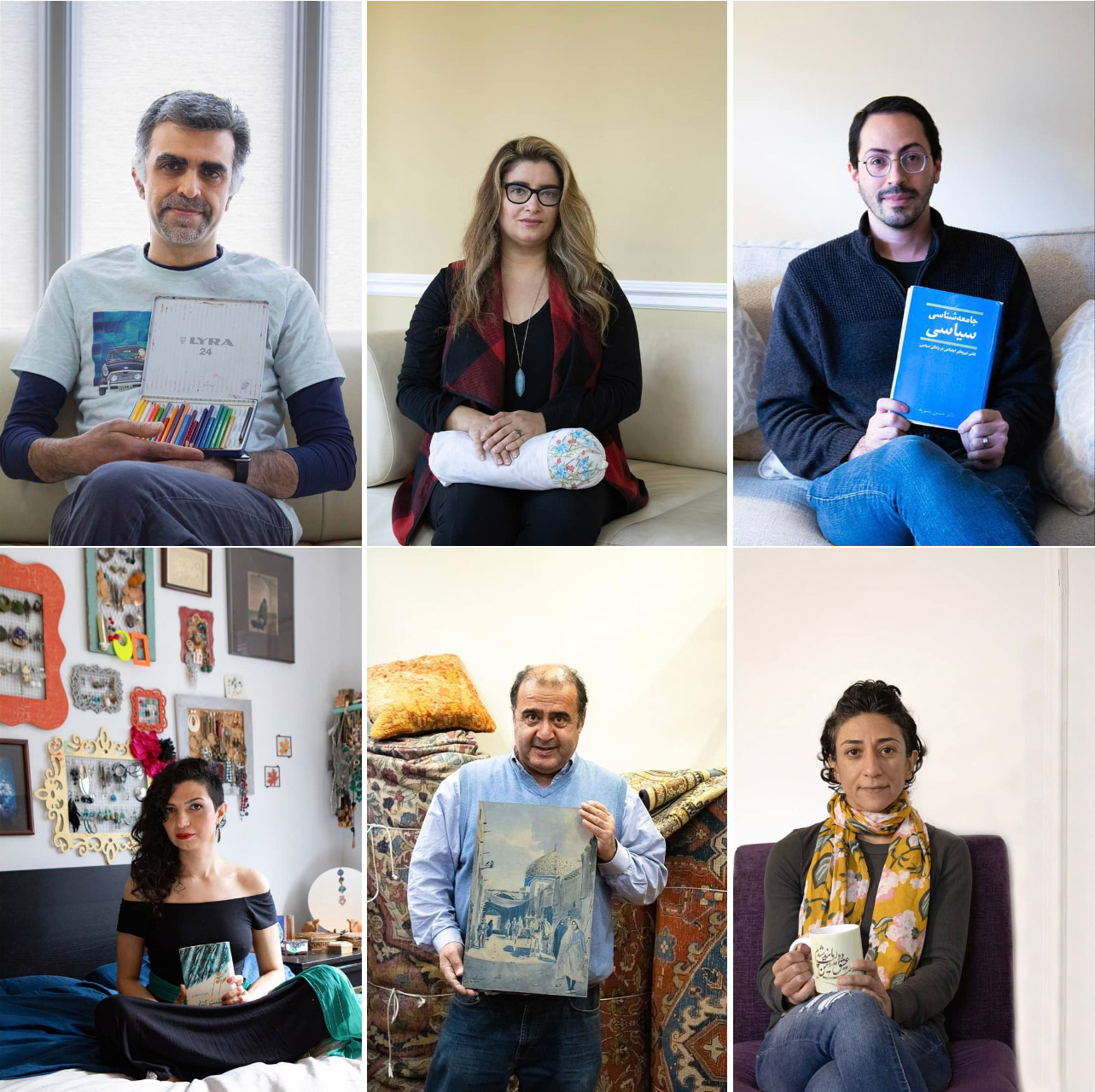
What Immigrants Bring is a project that explores immigration from the perspective of nostalgia, and how everyday objects, by virtue of their history, transcend their utilitarian relevance. See series: @whatwebring
I want the viewers to think about what it might be like to be uprooted and replanted, and then I want to think back 20 years in the future, with the immigration being an event in a distant past, and then I want them to think about what that experience might have been like–and that’s when I want them to look around them and identify what they might have kept so many years later. A belt? A backpack? A book? A family photo? A family recipe? Or, something else altogether?


L to R/ top to bottom: Reza, Photograph, 1978; Azi, Book of poems, 2001; Kaveh, Color pencils, 1986; Maryam, Mug, 2013; Anahid, Photo album, 2015; Semira, Pillow, 1989; Ali, Sociology textbook, 2012; Laleh, Tanboor, 2005.
I am an immigrant, and even though I have lived more than half of my life in the United States there is a part of me that still feels like a person in exile–perhaps because I have not been able to visit my homeland for seven years. Recently I have found myself longing for my country of birth. It is perhaps because of this longing that I have been incessantly rummaging through old closets to find whatever object I may have brought with me from Iran. Of these objects the ones from my first trip to the US, my displacement objects, are the most significant. These objects have survived numerous moves from apartment to apartment across several states over a span of twenty five years, but that’s not why they are significant: Far more importantly, they encapsulate something of the original excitement that I experienced when I moved to this country. These objects provide a bridge to my past, but at the same time they are a constant reminder that this is not home, that I am in exile. My experience is far from unique. Here I document the displacement objects of Iranian immigrants in the US.

Ramin, Boxed set of tapes, 1995
Self portrait
_____
I came to the US in 1995 for grad school.
I came to the US by myself, and met my wife here (well, in Washington DC in a dance club) six weeks after moving to the US. I think my parents were very disappointed that I did not go back to Iran after finishing my PhD.
A lot of my art is about my relationship with my upbringing in Iran. I grew up doing Persian calligraphy, and to this day in a lot of ways calligraphy forms the core of my artistic practice.
When do you feel the pull between your present life and your roots the strongest, and how do you reconcile those competing feelings?
This is an extremely complicated question, especially given the current political climate.
What is your hope centered around? What dreams are you building for yourself?
This is very much work in progress. I think, when one has grown up in a sort of environment where one is subjected to frequent traumas (revolution, war, cousins executed, etc) something happens to one’s notion of hope and, by extension, future. I know future will happen, but I don’t have a notion of future as such, I don’t have dreams, I don’t fantasize about my children growing up and doing great things, I don’t fantasize about getting old and retiring somewhere. These things don’t exist for me. Never have. Never will.
___
Butterfly Effect Digital Exhibit Artists
Akira • Mary Antar • Hrayr Attarian • Calayah • Sarah Elizabeth de Jesus Dutton • Lydia Gunn • Dilshad Icad • Ky • Ale Lemus • Toni Maugeri • Julia Obrien • Valeria Osornio • Roele Phantom • Mariana Perez • El Poeta / El Smith • Polly Devillier/Pretty Fucked • Lorena Salinas • Scribe • Anna Silivonchik • Ramin Takloo-Bighas • Cindy Uriostegui