
@calayahcore
Digital Performance, 2024
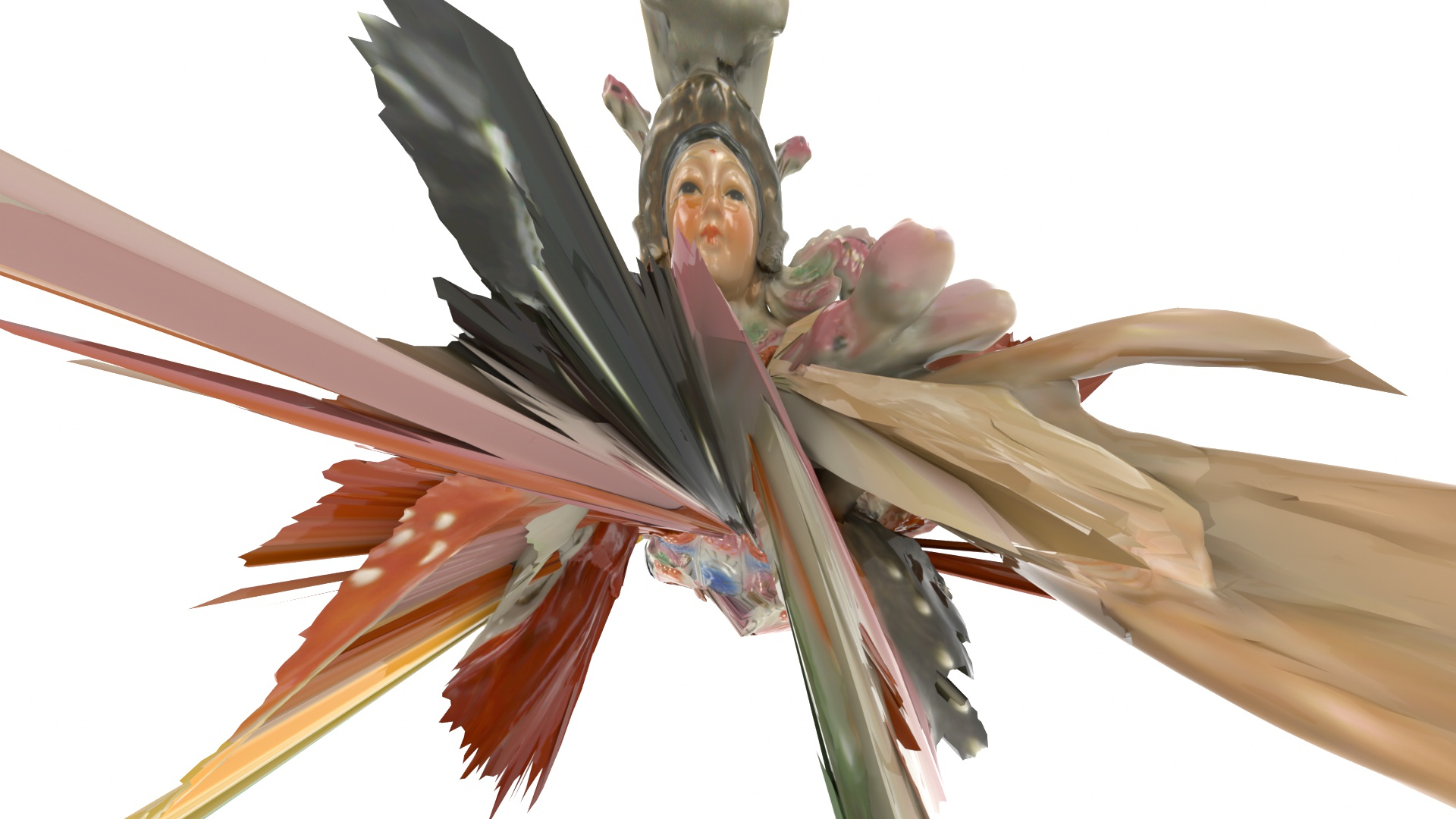
The Queen Mother of the West, a paramount goddess in Chinese mythology. She is a fossil, a plural. The power relations and social structures of different periods have squeezed and stretched, and gradually shaped her cultural sedimentary layers: the hermaphroditic Great Mother, who weaves heaven and earth; a piece of nowhere, worn, sheared, torn, bisected and carefully pieced together. She carries the sexual politics battles in mythology, revered and manipulated, flattered and wedded. Patriarchal writings subtly transfer female power, embedding themselves into the moral fabric of actions.
Through this digital performance, the artist sits in a chairless situation. As time flows, her body instinctively convulses in mid-air, succumbing to the point of exhaustion, ultimately falling to the ground. Gravity, muscle strength, and the power of ideas permeate and struggle within her. The scars of the image are glitches, a catastrophic yet exhilarating loss of control. They embraces degradation, objectification, and wounds, and forms new, positive forces.
_____
As a Chinese international student, my journey to the US is less a linear migration and more a shift in identity. Studying abroad places me in a permanent in-between state: never fully inside, never entirely outside. My “foreignness” is constantly produced through language, accent, visa status, and cultural expectations. The driving reason for this journey is not only education, but the need to gain distance—from familiar narratives, from inherited social roles, and from fixed ideas of belonging. In the US, I experience both opportunity and constraint, where visibility and marginalization coexist, shaping how I understand power, identity, and selfhood.
My immigration experience has reshaped my relationship with both my family and my community into something more dispersed and less stable. Physical distance has weakened everyday intimacy, but it has also made our connections more intentional and reflective. With my family, care is often expressed through absence, delayed conversations, and unspoken concern rather than daily presence. My community now feels fragmented and mobile—formed through shared foreignness, temporary belonging, and mutual recognition among other migrants. It is not rooted in place, but in experience. It feels fragile yet supportive, marked by empathy, distance, and a constant negotiation of identity across borders.
My relationship to home and tradition has shifted from familiarity to critical distance. Home is no longer a fixed place, but a layered memory shaped by language, rituals, and inherited expectations. Living abroad has loosened tradition’s authority: practices that once felt natural now appear constructed, gendered, and political. At the same time, distance has made certain traditions more fragile and intimate, something I choose to carry rather than automatically inhabit. Home now feels partial and mobile—less about return, more about how I negotiate belonging, care, and identity across different cultural and ideological spaces.
I feel the pull most strongly in moments of decision and vulnerability—when I have to choose how to speak, what values to defend, or how to imagine my future. These moments expose the gap between inherited expectations and the life I am building now. The tension intensifies during family conversations, cultural rituals, or encounters with authority, where older frameworks quietly resurface. I reconcile these feelings not by resolving them, but by holding them in parallel. I accept contradiction as a condition of migration, allowing friction between past and present to become a space for reflection rather than a demand for coherence.
My hope is centered on creating space—intellectual, artistic, and bodily—where complexity is allowed to exist without simplification. I am building dreams that are not about stability in the traditional sense, but about agency: the ability to speak in my own voice, to question inherited structures, and to transform tension into form. Through research and artistic practice, I hope to make visible the forces that shape identity, gender, and power, especially for those who live between cultures. Rather than aiming for arrival or resolution, my dream is to sustain movement, curiosity, and ethical responsibility in an uncertain world.
___
Butterfly Effect Digital Exhibit Artists
Akira • Mary Antar • Hrayr Attarian • Calayah • Sarah Elizabeth de Jesus Dutton • Lydia Gunn • Dilshad Icad • Ky • Ale Lemus • Toni Maugeri • Julia Obrien • Valeria Osornio • Roele Phantom • Mariana Perez • El Poeta / El Smith • Polly Devillier/Pretty Fucked • Lorena Salinas • Scribe • Anna Silivonchik • Ramin Takloo-Bighas • Cindy Uriostegui