
@sedphoto
As a nomadic, multidisciplinary artist, Sarah Elizabeth Dutton is deeply inspired by the interpretation process, particularly in how it informs interdependence and relational health overall as well as continuously redefines and reorients the histories and futures, traditions, and foundations of a person, place, thing, or idea. Her practice is continuously rooting through themes around agency, reverence, impermanence, memory, grief, intersectionality, biophilia, reciprocity, belonging, and sovereignty.

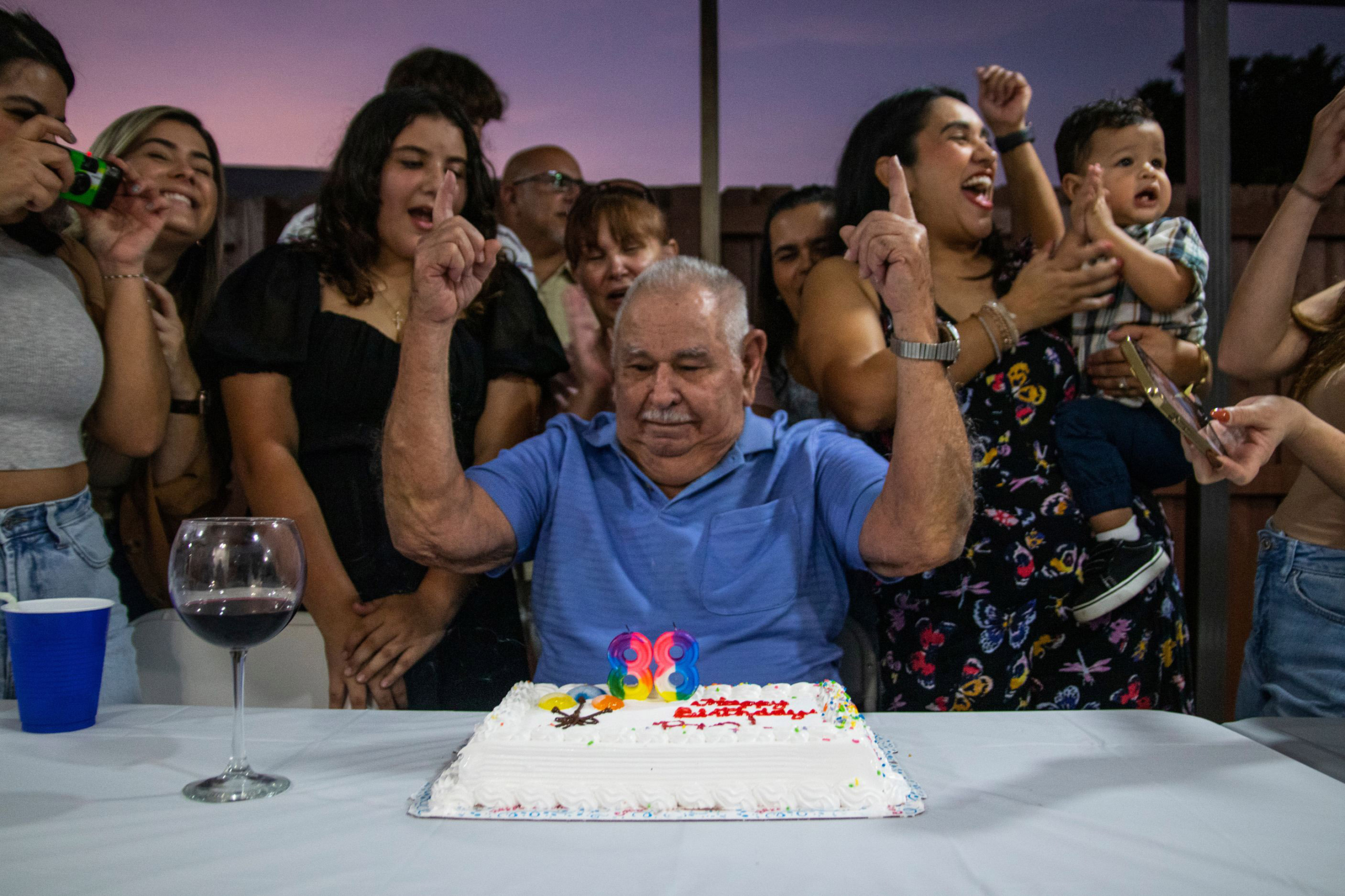
Te Amo, Bolita
12.05.2022, Photography, 12×10
We gather every single year as a family, whether we can all make it or not, to be present for my abuelo as he continues to get older. We’re not sure what we’ll do when he passes, as he truly holds us together in a profound way having not only been one of the main reasons we immigrated but also stayed together after my abuelita passed within the first 3 years after they did. He has never married since. When I took this photo, it had been over a decade since I saw my family last, and I realized I hadn’t taken that many photos not for work and been surrounded by loud laughs like mine in a very long time. I truly hope when he does pass, even if we don’t all remain as close, that we each can remind each other what we mean to each other and our family in one way or another. My way will be these photos, and I’m grateful for Papi letting me become an artist in this way, ultimately my way, as I believe it is the most honorable way to be family.

Vaquero
12.06.2022, Photography, 12×10
Even though I do not know how to speak Spanish, whenever I get the opportunity to visit my family in Homestead, I always lay on the couch and watch Telemundo or whatever else Papi wants. On this particular trip, I spent almost 3 whole days on the couch with Papi, and somehow cowboy movies were the most prevalent thing we watched. At one point, I used a translator to ask if he’d ever ridden a horse. He said, “Si.” I then jokingly said, “Ah, tu vaquero!” and he let out a laugh I’ll always be proud of. This particular trip I also prioritized taking portraits of everyone in the family, with an emphasis on mi abuelo. As I age, I am grateful for how much he has allowed me to photograph him and our family’s life over the years. To this day, I still call him vaquero, and he smiles, and it always reminds me intimacy within family can take shape however you’d like.
____
I’m unfortunately not as familiar with my father’s side of the family, as they are Irish, Italian, and more far removed and disconnected from their immigration story within their lineage. However, I am very familiar with my mother’s side of my family as they immigrated from Cuba to the United States on October 27, 1971 to Homestead, Florida due to wanting a better life than was offered in Cuba despite loving their home profoundly. My abuelo and abuelita had their own farm homestead and ceramic business, which would eventually become unsustainable after my abuelo was taken and put in concentration camps during Fidel’s reign for disagreeing with the application of the revolution and evolving rule of law. If it wasn’t for my great aunt and uncle who immigrated first to the United States and earned enough money to help them leave, I’m not sure they ever would have left and if I’d be here today. Because the citizenship process is complicated, and taxing both financially and energetically, they each processed it at different times and struggled in their own ways with assimilation even to this day. A particularly resonant part of my journey would be Papi, mi abuelo. His name is Patrocinio Garcia, but we call him Papi for short, and he is truly the honey that keeps our family together on my mother’s side of the family. We’re incredibly lucky to still have him at 91 years old and remain rooted in our shared reverence for all he has done for our family to be what it is today. After mi abuelos and their 6 children courageously immigrated from Cuba, they would become even more tender within the first year as they welcomed a 7th child, grieved the loss of mi abuela just shy of 3 years, and lost half of their belongins in a house fire right after the 5th year. With the help of the community my family cultivated, he rebuilt the house for mi mama, tios, y tias. We still have the same house in the same cul-de-sac with family now in the other houses, and he has not been with anyone or married since. I am never not moved when I reflect on how my grandfather was in a new country with 7 kids and somehow managed to curate a sustaining, beautiful life for himself, his kids, and consequently our lineage and his legacy.
My immigration story has impacted my relationship with my family and community significantly. I almost never feel Hispanic or White enough in American culture. My father’s lineage is Irish and Italian, so I inherited a lot of physical genetics that allow me to pass as white in this western culture, however I also inherited a lot that allows me to belong to Hispanic spaces. For better and for worse, my father has a military background, so there was a lot of movement that further disconnected me from my roots as my nuclear family moved a lot, mostly before I was born, and we have remained in south Mississippi since I was born. Also, my nuclear family is very dysfunctional and unhealthy, because both of my parent’s upbringings were full of poverty and the generational trauma is significant. This adds another layer of disconnection. I do not hold this against my parents, and funnel this awareness and emotional charge in my advocacy work regarding systemic issues. Thankfully, we took trips each summer to visit either family for the whole summer, and those memories are the foundational elements for rooting me to my relationship to my heritage and how I show up in similar spaces as an adult. For example, I can feel a deep pivot in my embodied experience at gatherings centralized around my heritage whether it’s connecting with others on the music playing or speaking the little Spanish I have retained from childhood. This means that I both feel a strong sense of connection yet always on the outskirts without ever feeling a true, deep sense of belonging in both my nuclear family and communities overall. This also means that is overlaps with other parts of my identity, such as sexual orientation, financial status, morals and traditions, and professional work, that both sides of my family have challenges with, which consequently has forced me to interpret family and community as including chosen family and blending my immigration story with others.
I don’t have a stable relationship to the applications of tradition beyond the whitewashed, capitalistic versions of tradition we were able to afford to participate in growing up. However, I have always had a strong reverence for the idea of tradition and how it is a constructive and sacred conduit for culture to be shared across time and space. It has changed to only grow increasingly more potent over the years as I curate my own that honor the life I want to create outside of settler colonialism while still pulling from the historical remnants that have survived across generations of similar traditions. For example, I have a deep affinity to larger families and gatherings, especially the physical presence and intimacy that comes with it. However, I am mostly removed from that part of my life for many reasons, and I crave it and cultivate it whenever possible to be more commonplace in my life as I age.”
I feel the pull between my present life and my roots the strongest in both the participation and receiving of photography as a medium of art and documentation as well as in deep grief. If you ask any of my friends what is something that I love to do or about photography, it will be them sharing their childhood or generally any photos throughout their life with me as well as my photographing while around them and them likely never receiving the photos as it’s me simply documenting everyday life. I will always feel the most close and distant to my family through photos that ultimately are the archives of my lineage, because I am straddling both the gratitude of knowing them more and awareness of how much more I could know them if it weren’t for the colonial powers across time impacting these everyday lives so significantly. The grief is immeasurable and something I still and will likely always struggle to navigate. It shows up in the ways you expect and don’t. The grief will show up when it approaches a loved ones birthday, especially Papi’s where the entire family will always gather at my Aunt Millie’s and Uncle Julio’s, and I want to travel to see them but can’t. Whether I can’t travel due to finances from a lack of generational wealth, the fear of an administration’s method for navigating immigration (especially recently), or simply insecurity around belonging from being more separated compared to everyone who lives next door to each other, I always feel the pull of grief.
I felt it tremendously this past trip home to Homestead as I spent the majority of my trip suddenly helping others ensure their paperwork was ‘efficient’ enough for them to feel safe with the current escalation in efforts by ICE, when I could have spent it in ways much more resonant and healing for myself and my family. The grief will also show up for example in my relationship with my mom, when she doesn’t have her end of life care sorted due to avoiding it from the loss of her mother so young and lack of education as immigrants or even simply her lack of understanding of our nation’s history and operations and how these are things others may take for granted that are more commonplace for non-immigrant folks. It also shows up somewhere in the middle of both, such as being overcome with emotion quite a few times in this submission process both in reflection and practice. I’ve learned throughout time how creative my family was, and I only wish I could learn and connect with them during times like this as I pursue the same need and desire to create as they did.
My hope is centered around truth-telling, youth, and art, which consequently becomes about love, relational health, and the fight to expand the individual, interpersonal, and collective imaginations. I truly believe interpretation is the foundational conduit for all change in the human experience and that we play a significant role in it all, particularly in passing the baton to younger generations. My dreams are being built on the advocacy and art making around claiming your story in communal spaces to feel the breadth of the human experience, and I honor the next generation of thought leaders to continue shared stewardship of the human experience.
___
Butterfly Effect Digital Exhibit Artists
Akira • Mary Antar • Hrayr Attarian • Calayah • Sarah Elizabeth de Jesus Dutton • Lydia Gunn • Dilshad Icad • Ky • Ale Lemus • Toni Maugeri • Julia Obrien • Valeria Osornio • Roele Phantom • Mariana Perez • El Poeta / El Smith • Polly Devillier/Pretty Fucked • Lorena Salinas • Scribe • Anna Silivonchik • Ramin Takloo-Bighas • Cindy Uriostegui